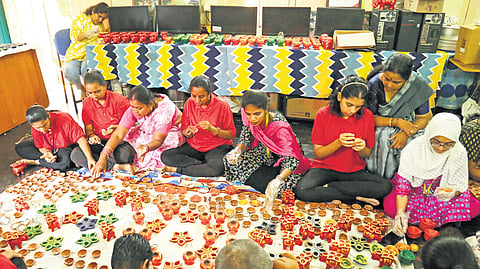

VISAKHAPATNAM: At Prajwal Vani Welfare Society in Visakhapatnam, rows of handmade clay diyas line the tables, are painted, packed, and ready for sale. Each diya has been shaped and coloured by specially-abled or down syndrome or autistic children as part of the Visakha Kushideep Project, an initiative that brings skill training and self-reliance to the centre of Diwali preparations.
Started in 2013, the project involves children with various disabilities who are trained to make diyas, candles, and decorative items during the festive season.
This year, they have completed 2,000 diyas, including 1,000 candle diyas, with an additional focus on elephant-shaped and chimney-style diyas, designed to be used even after the festival ends.
“Every year, people throw away diyas after Diwali,” said Suchitra, founder of the society. “So this time, we made elephant shaped diyas that can be kept as decorative items. Chimney diyas also serve the same purpose. We want the work of these children to stay in people’s homes.”
The children are trained not just in making the diyas, but also in painting them using red, green, and blue colours.
These colours are deliberately chosen. For children with Down syndrome, they support better visual recognition and help them understand, sort, and count diyas. The training also includes basic handling of money and customer interaction.
A formal request has been sent to CMR Central to allot a stall where the children can sell the diyas directly to buyers. Prices range from `50 to `350. The money earned goes to the children, many of whom make their own small purchases during Dhanteras, a part of the process that builds confidence and ownership.

Aadhithi Varma, an autistic child, was kept locked at home until the age of six and a half. She joined the centre six years ago. After receiving counselling and support, she began speaking, writing, and forming friendships, including one with a visually impaired girl. She completed her 10th through open schooling, then vocational intermediate, and is now pursuing a regular degree course at SKML College. She contributed to this year’s diya painting and has learned to be independent in the city.
Naveen, who has Down syndrome, had limited exposure to the world during his early years due to health issues.
He began learning at the age of four, completed 10th and intermediate, and is now pursuing graduation. Today, he travels independently by bus or app-based transport and designed 200 of the 2,000 diyas made this season. Lokesh, who is hearing impaired, has completed both ITI and graduation.
He played a key role in the painting work this year. Though he does not speak, he communicates with other children using sign language, and they include him in every stage of the process.
Pranay, with Down syndrome, lost both his parents and was brought from Vizianagaram by his uncle. He is a cyclist and runner and has reached national-level para sports, winning a silver medal.
He has completed his 10th. He trains under Andhra University, which is currently hosting para-athletics in the region. “Disability is not a disease. What they need is training, support, and the right opportunities. This project gives them that space, and Diwali becomes more than just a festival. It becomes a step forward,” said Suchitra.