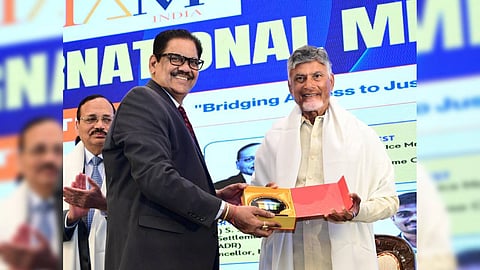

VIJAYAWADA: Chief Minister N Chandrababu Naidu has expressed his government’s readiness to establish an International Arbitration Centre in Visakhapatnam, aiming to create an Alternative Dispute Resolution (ADR) ecosystem, surpassing Singapore’s globally recognised model.
Speaking as a chief guest at the International Mediation Conference organised by the Asian Centre for International Arbitration and Mediation (ACIAM) in Visakhapatnam on Friday, Naidu emphasised that the ease of justice system, driven by mediation and arbitration, ensures swift and accessible justice.
He highlighted India’s rich tradition of mediation, citing Lord Krishna as an exemplary mediator, and noting how our ancestors and village elders historically resolved disputes.
Naidu underscored that India’s judicial system, a cornerstone of democracy, upholds constitutional rights with commitment, impartiality, and transparency, instilling public confidence despite occasional delays.
He stressed that robust ADR mechanisms are essential to reduce disputes, stabilise the economy, and bridge the gap between haves and have-nots for a healthier society. He noted that conventional legal processes can be intimidating for many, making mediation a dignified alternative.
With increasing companies and systems, Naidu advocated for technology-driven ADR systems to ensure accessible justice, alongside establishing new courts to address rising caseloads.
AP HC Chief Justice calls for 800 more judges to address pendency of cases
He highlighted the State’s use of technology, delivering 700 services via WhatsApp, and incorporating virtual hearings, e-filing, and mobile updates to enhance judicial accessibility under the ease of justice initiative.
The Chief Minister outlined Andhra Pradesh’s emergence as a global technology hub, with investments worth $100 billion in the past year from companies like TCS, Cognizant and Google, and the latter is set to establish a data centre in Visakhapatnam within one or two years, surpassing India’s existing data centre capacity. He also announced plans for a Quantum Computing Centre in Amaravati, positioning India as the sixth country globally to implement quantum computing by January 1, 2026, describing it as an emerging ‘Quantum Valley’.
Andhra Pradesh High Court Chief Justice Dhiraj Singh Thakur highlighted the need for additional judicial resources, noting that the State’s current 650 judges are inadequate, requiring 800 more to clear case backlogs. He proposed a mandatory 40-hour mediator training programme, with 1,400 mediators already trained, and 800 more to be trained by December, and called for a certification system to evaluate mediator proficiency. He also addressed the role of retired judges and bureaucrats in arbitration, urging a mechanism to ensure integrity due to the presence of both honest and dishonest arbitrators.
Supreme Court Judges Surya Kant and PS Narasimha emphasised trust as the cornerstone of mediation and arbitration, while National Law Institute Bhopal Vice-Chancellor Prof S Suryaprakash proposed an International School of Maritime Law in Visakhapatnam, citing its long coastline, and rising maritime disputes, currently handled primarily in Mumbai.
The conference, attended by legal experts and judges, was welcomed by Chitra Rentala, partner at Trilegal, and addressed by Prof Surya Raju, Secretary General of ACIAM India.
Plan to set up Space City
The Chief Minister has revealed plans to develop a Space City near Tirupati, aimed at positioning Andhra Pradesh as a key player in the global space sector. The initiative will focus on launching private satellites, drawing inspiration from SpaceX, and is expected to foster innovation, and attract investment in space technology.
Naidu highlighted that this project marks a significant shift from merely observing space achievements to actively contributing to them, aligning with the State’s broader vision to advance technological frontiers.
The Space City will complement other futuristic initiatives, such as the Drone City, and the Quantum Computing Centre in Amaravati, reinforcing Andhra Pradesh’s commitment to pioneering advancements in science and technology. This development is poised to create new opportunities for collaboration with private space enterprises, and enhance AP’s role in India’s growing space ecosystem.
