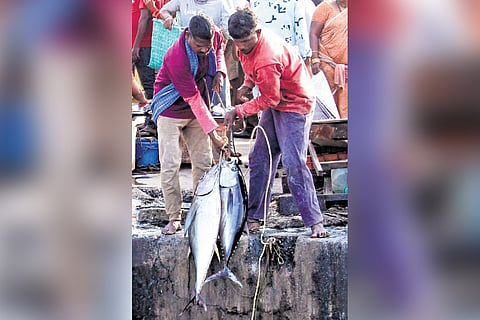

VISAKHAPATNAM: Visakhapatnam has the resources and catches volume to emerge as a leading centre for the tuna industry on India’s east coast. However, experts and fishermen agree that this potential can be realised only if value addition is carried out locally, instead of the catch being processed and branded elsewhere.
Over the past four years, the city has recorded strong but uneven tuna landings. According to official fisheries data, total tuna landings increased from 9,696 tonnes in 2022-23 to 12,029 tonnes in 2024-25, before declining to 10,278 tonnes in 2025-26.
Despite these volumes, most of the tuna is sold in raw form, fetching modest prices for fishermen.
Among the different species, Yellowfin tuna (Thunnus albacares) showed wide fluctuations. Landings rose from 3,562 tonnes in 2022-23 to 5,698 tonnes in 2024-25, but dropped to 3,526 tonnes in 2025-26.
Skipjack tuna (Katsuwonus pelamis) provided some stability, with landings steadily increasing from 1,456 tonnes in 2022-23 to 2,436 tonnes in 2025-26. Little tuna (Euthynnus affinis), which formed the largest share in 2022-23 at 4,489 tonnes, declined to 3,684 tonnes in 2024-25, and later stabilised at 3,782 tonnes in 2025-26, raising concerns about overfishing.
Fishing juvenile tuna will reduce stock levels: Expert
Catches of other tuna species, including Thunnus, Sarda and Auxis, remained limited, reaching 568 tonnes in 2024-25, compared to just 146 tonnes the previous year. Commenting on the trends, P Lakshmana Rao, Joint Director of Fisheries, Visakhapatnam, said while mechanised fishing has improved landings, long-term sustainability and better post-harvest handling are essential.
“The fluctuations show why we must protect fish stocks. We are advising fishermen to avoid catching juvenile fish,” he stated.
Fishermen say the main challenge lies beyond the sea. The absence of modern facilities for grading, freezing and processing tuna means that much of the value is added outside Vizag.
“We land good-quality tuna here, but without processing units, we are forced to sell it at low prices,” said Vasasupalli Janaki Ram of the East Coast Mechanised Boat Owners Association of India.
At present, tuna is sold locally at about Rs 130-150 per kg. “If processing units are set up in Visakhapatnam, the same fish can fetch nearly double the price. That will benefit fishermen and help the city become a true tuna hub,” he added.
Industry observers note that developing processing infrastructure and cold-chain facilities could not only improve incomes but also strengthen Visakhapatnam’s position in domestic and export markets, shifting its role from a landing point to a centre for value-added tuna products.
“In some cases, fishermen also catch juvenile fish, which is a serious concern. While it may result in better catches in the short term, continued juvenile fishing will quickly reduce stock levels. If this practice continues, tuna could go the way of several other species that are now rarely seen. Resource management must focus on the future, not just immediate gains,” an expert said.
