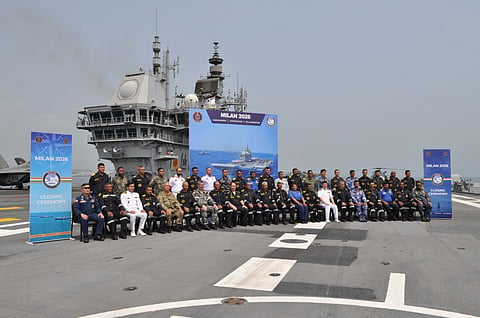

VISAKHAPATNAM: From a modest beginning in 1995 with five participating countries to the presence of around 75 friendly foreign nations this year, the 13th edition of Exercise MILAN concluded on Wednesday aboard the indigenous aircraft carrier INS Vikrant off the coast of Visakhapatnam.
Hosted by the Indian Navy under the theme “Camaraderie, Cooperation and Collaboration,” MILAN 2026 marked its largest edition to date. Conducted in two phases including harbour and sea, the exercise brought together ships, aircraft and personnel for professional exchanges and coordinated operations in the Bay of Bengal.
The sea phase, held from February 21 to 25, witnessed the participation of 42 ships and 29 aircraft, including 18 ships and five aircraft from friendly foreign countries. For the first time, the Philippines, the United Arab Emirates, Oman, South Africa, and South Korea joined the exercise. The closing ceremony was held in a distinctive format, with Commanding Officers of participating ships embarking on INS Vikrant.
Addressing the gathering, Rear Admiral Alok Ananda, Flag Officer Commanding Eastern Fleet, said, “India is a nation with a rich maritime heritage, where oceans are seen as bridges that connect nations and foster collective security and shared prosperity.”
He noted that Exercise MILAN embodies this approach by bringing diverse navies together under a shared commitment to maintaining a safe and secure maritime environment.
Referring to the harbour phase, he explained that it featured structured professional engagements, including subject matter expert exchanges, the MILAN Young Officers’ programme and pre-sail planning conferences. “These interactions are aimed at enhancing mutual understanding, sharing best practices and strengthening interoperability before we move to sea,” he observed.
During the sea phase, participating units undertook coordinated exercises across air, surface, and sub-surface domains. The aerial component included Advanced Coordinated Anti-Submarine Exercises (CASEX), Air Defence Exercises (ADEX) and Over the Horizon Targeting missions, with about 90 hours of flying undertaken by participating aircraft. Maritime patrol and surveillance aircraft such as P-8A from the US, Atlantique from France and an MH helicopter from Australia operated alongside Indian Naval platforms including the P-8I and MH-60R helicopters. For the first time in MILAN, deck-based MiG-29K fighters operating from INS Vikrant were integrated into an air defence exercise.
At sea, ships carried out tactical manoeuvres, communication drills and coordinated anti-air and anti-surface operations, including live gunnery engagements against designated targets. Visit, Board, Search and Seizure (VBSS) drills simulated maritime interdiction scenarios, while foreign warships undertook Replenishment at Sea with the fleet tanker INS Shakti to demonstrate logistical cooperation during extended deployments.
Rear Admiral Ananda highlighted that the scale and complexity of the exercise were designed to enhance operational synergy, build mutual trust and improve collective readiness in a dynamic maritime environment. “India is increasingly self-reliant in warship construction,” he remarked.
Reflecting on the growth of MILAN from five participating nations in 1995 to 75 this year, he pointed out that the expansion itself reflects the trust and professional credibility India has built in the maritime domain. “The very willingness of friendly foreign countries to send some of their finest ships and personnel speaks of the confidence they repose in India and its Navy,” he added, underscoring that the core objective of MILAN remains fostering camaraderie, cohesion, and collaboration among participating navies.
