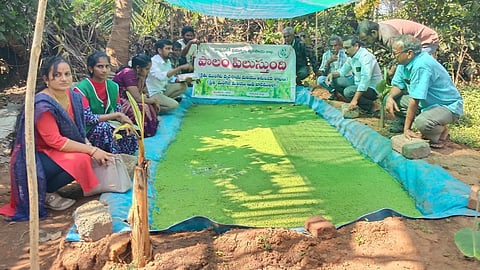

KAKINADA: TUNI mandal stands at the top in Kakinada district in reduc ing urea consumption by 53.91 percent during Rabi 2025-26. This saved approximately Rs 34.40 lakh in market value and 2.58 crore in government sub-sidy for the Central government.
Both Central and State gov-ernments are urging farmers to reduce use of urea and im-plement natural farming.
The State Agriculture De-partment released a urea sales analysis report on Wednesday.
The "Urea Card System" and natural farming are being prac-tised in Tuni mandal, with 1,700 farmers adopting natural farm-ing completely and another 2,100 adopting it partially. This has significantly reduced de-pendency on chemical nitrogen fertilisers.
Tuni mandal consists of 20 villages with 20 Rythu Seva Kendrams, where 3,680 hec-tares of paddy are cultivated.
For this crop, an average of 828 metric tonnes of urea is re-quired. Additionally, 121 acres of land are being cultivated with seasonal horticulture crops, which require 27 metric tonnes of urea; 5,110 acres are under perennial horticulture crops, which require around 460 metric tonnes of urea.
In October 2025: 2,825.68 MTs of Urea were utilised for the Rabi Paddy crop.
November-1,734.88 MTs, De-cember - 7,763.97 MTs, and Jan-uary 2026: 10,119 MTs urea was utilised in the Kakinada dis-trict which consists of 20 mandals.
Farmers in Tallarevu Man-dal are utilising the highest quantity of urea, with Koth-apalli Mandal in second place due to overconsumption. Yeleswaram mandal ranks third. Urea consumption is be-ing reduced in Tuni, Kakinada Rural, Kotananduru, Gollapro-lu, Gandepalli, and a few other mandals.
