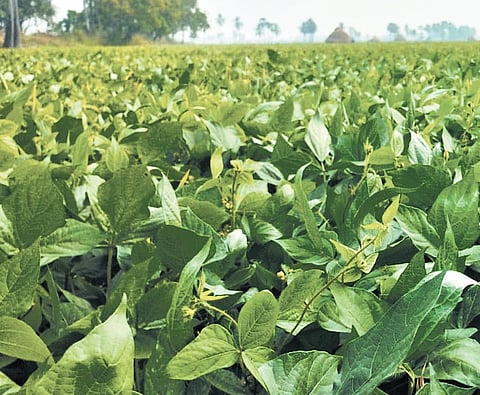

VIJAYAWADA: Farmers across the State have shifted to pulse crops during the Rabi season as limited irrigation water reduced the scope for water-intensive paddy cultivation. Limited availability of irrigation water in canals and reservoirs has reduced the scope for water-intensive paddy, prompting cultivators to adopt short-duration, low-water pulses that suit the prevailing conditions.
According to the latest crop sowing data, the total cropped area in the State has reached 17.05 lakh hectares (against normal area of 20.69 lakh hectares), which is 82 per cent of the normal Rabi area. Importantly, sowings have exceeded the normal progress for this season, standing at 111 per cent of normal area as on date, reflecting agricultural activity despite water constraints.
A striking feature of the current Rabi season is the dominance of pulses over paddy. Pulses have covered 6.39 lakh hectares, reaching 97 per cent of the normal area as on date, while paddy has been sown in 5.79 lakh hectares, achieving only 78 per cent of the normal seasonal area. It reflects the changing priorities of farmers facing water supply problems.
Among pulse crops, Bengal Gram continues to occupy the largest area, with 3.02 lakh hectares sown so far. It is in the vegetative to flowering stage, indicating timely sowing and good crop establishment. Blackgram, covering 2.34 lakh hectares, and Greengram, cultivated in 0.49 lakh hectares, have recorded significant expansion this season.
Both crops are progressing from the vegetative to flowering stages, benefiting from their short duration and modest moisture requirements. Red gram, horse gram and other minor pulses have added to the overall pulse acreage across several districts.
Sayana Narayana Rao a farmer from Bethavolu, Krishna district said that he has been cultivating black gram during the rabi season due to water scarcity for the past few years. He said he used to cultivate paddy during rabi too which brought more profits compared to Kharif season. He added that he sporadically cultivates okra to get investments in Rabi season.
In comparison, paddy cultivation has remained largely restricted to assured irrigation pockets, where water availability allows nursery raising and transplantation. Paddy crops are currently in transplantation stage at the nursery, a phase that demands consistent water supply. In tail-end areas and regions with delayed canal releases, many farmers have consciously avoided paddy, opting instead for pulses that offer flexibility and lower risk.
Beyond pulses and paddy, the Rabi season has also seen encouraging trends in coarse cereals. Maize has exceeded normal coverage with 2.67 lakh hectares, and is now in the grain-filling stages. Jowar, sown in 0.67 lakh hectares, has reached the grain-filling stage, contributing to overall food grain stability.
Oilseeds have recorded lower coverage at 0.63 lakh hectares. Groundnut, sown in 0.48 lakh hectares, is progressing from seed emergence to peg formation, while sesamum is at the vegetative to flowering stage. Tobacco, a key commercial crop, has shown steady progress and is currently in the seedling to flowering initiation stage.
The sustained expansion of pulses over paddy reflects farmers’ practical adaptation to water availability, marking a trend in the state’s Rabi agriculture.