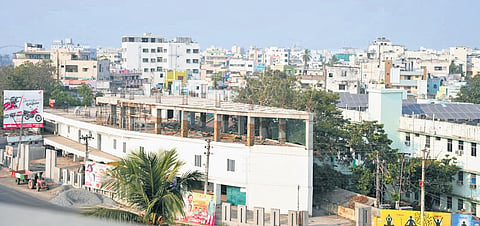

RAJAMAHENDRAVARAM : Air quality in the historic river city of Rajamahendravaram has deteriorated sharply, with pollution levels now exceeding national safety benchmarks. The alarming rise comes at a critical juncture as preparations gather pace for the upcoming Godavari Maha Pushkarams, expected to draw lakhs of devotees from across the country.
Raising the issue in Parliament recently, MP Daggubati Purandeswari urged the Union government to allocate Rs 150 crore under a Clean Air Package to mitigate pollution in the temple town before the mega religious event. She warned that failure to address the worsening air quality could pose serious health risks to visiting pilgrims.
Air pollution in Rajamahendravaram has shown a steep and statistically significant rise over the past four years, with the city’s annual average Air Quality Index (AQI) increasing from 85 in 2022 to 171 in 2026 — a 101 per cent surge.
The latest figures place the historic river city in the ‘Poor’ category under national AQI classification standards, raising serious public health concerns ahead of the upcoming Godavari Maha Pushkarams.
Data compiled from national air quality monitoring systems indicate worsening pollution trends.
Exposure to AQI levels increases risk of pulmonary problems
After recording an annual average AQI of 85 in 2022, the city saw a rise to 96 in 2023, a marginal dip to 82 in 2024, followed by a jump to 104 in 2025.
The most dramatic escalation occurred in 2026, when the average AQI climbed to 171, crossing the threshold from ‘Moderate’ to ‘Poor’. By comparison, AQI values between 0–50 are categorised as ‘Good’, 51–100 as ‘Satisfactory’, 101–150 as ‘Moderate’, 151–200 as ‘Poor’, 201–300 as ‘Very Poor’, and above 300 as ‘Severe’.
Recent hourly data underline the severity of the problem. On Sunday, the AQI peaked at 220 at 5:00 a.m. and remained at 210 at 7:00 a.m., both readings falling in the ‘Very Poor’ category.
Although levels declined to 140 at 4:00 p.m (Moderate), they climbed again to 180 by 8:00 p.m., indicating sustained pollution throughout the day.
In December 2025, the city recorded its highest recent AQI of 224, while the lowest reading in recent years was 31 in August 2022, reflecting a wide but increasingly upward fluctuation range.
Environmental health assessments suggest that current particulate matter exposure — particularly PM2.5 (Particulate Matter 2.5 micrometers) and PM10 (Particulate Matter 10 micrometres) — is equivalent to inhaling pollutants comparable to smoking approximately 3.4 cigarettes per day.
Noted pulmonologist Dr Guduri Srinivas warned that prolonged exposure to AQI levels above 150 significantly increases risks of asthma exacerbation, chronic obstructive pulmonary disease (COPD), ischemic heart disease, sinusitis, and dermatological conditions.
East Godavari Collector Kirthi Chekuri, while interacting with the media recently, expressed concern over the sharp rise in AQI levels in Rajamahendravaram.
Sharing recent pollution statistics, she termed the trend alarming and urged public participation in reducing emissions, controlling waste burning, and supporting green initiatives to restore clean and healthy air. Officials attribute the rising AQI to vehicular emissions, construction dust, road re-suspension particles, and localised industrial activity.
While the RMC has initiated intermittent chemical spraying to suppress airborne dust, environmental analysts argue that such measures address surface-level symptoms rather than structural causes. With annual averages breaching 170 and peak hourly levels crossing 220, the city now faces an urgent need for sustained air quality management interventions, including continuous monitoring, emission regulation, green belt expansion etc.
Public health experts emphasise that without immediate corrective measures, the city’s air quality trajectory may continue its upward climb into the Very Poor category on a more consistent basis.
