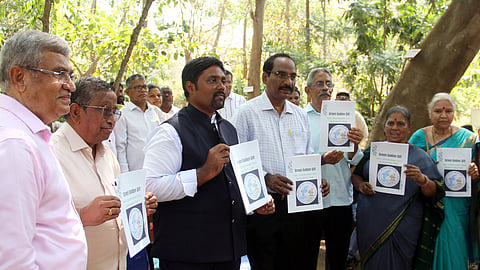

VISAKHAPATANAM: What was once a hospital waste disposal site has been transformed over the past 25 years into one of Visakhapatnam’s prominent biodiversity parks through the efforts of of the Dolphin Nature Conservation Society.
The Biodiversity Park, developed within the premises of the RCD Rani Chandramani Devi Government Hospital with the support of the Visakhapatnam Metropolitan Region Development Authority (VMRDA), completed 25 years on Thursday. To mark the silver jubilee, VMRDA Metropolitan Commissioner N. Tej Bharath released a commemorative souvenir.
A two-day workshop on biodiversity also began at the park as part of the celebrations.
Speaking on the occasion, Tej Bharath said the park has been providing valuable learning opportunities not only to students from Visakhapatnam but also to those from neighbouring States.
He noted that the park houses a wide variety of plants, including wild species adapted to different climatic conditions, several medicinal plants, and rare flowering species.
“Some plant varieties that are on the verge of extinction are also being conserved at the park. It is a living example of the importance of biodiversity conservation,” he highlighted. Appreciating the efforts in establishing and maintaining it, he assured continued support from VMRDA for the park’s development and encouraged the organisers to work towards establishing more such biodiversity parks.
The park was developed under the guidance of marine biologist and former professor Dr Mantha Ram Murty and his wife Mangathayi, who founded the Dolphin Nature Conservation Society in 2001.
With the support of volunteers and students, an abandoned wasteland within the hospital premises was gradually converted into a biodiversity park.
Spread across about three acres, the park is conservation site that protects plant species outside their natural habitats. It is the first such biodiversity park in Andhra Pradesh and among a few in the country.
The park now hosts more than 2,000 species of plants, including rare and endangered varieties.
Different sections of the park represent varied ecosystems such as forest, aquatic and arid landscapes.
It also includes collections of orchids, medicinal and herbal plants, insectivorous species and sacred groves. The site attracts butterflies and birds and serves as an outdoor learning space for students.
