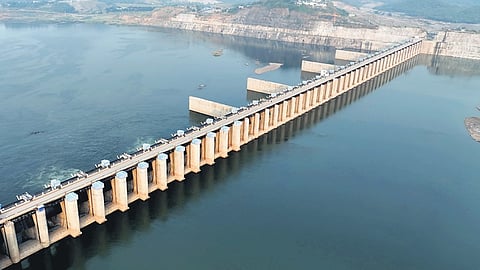

VIJAYAWADA: The CAG has released a detailed performance audit of the Polavaram Irrigation Project (PIP), revealing persistent delays, financial mismanagement, irregular contracting practices, and inadequate rehabilitation measures for displaced families.
Covering the period from 2017-18 to 2022-23, the audit highlighted systemic weaknesses that continue to plague one of India’s most ambitious irrigation projects.
CAG found that financial management has been a major concern. Budgetary support from the state government had declined sharply between 2019 and 2023, with utilisation ranging from just 21 to 66 per cent.
Spending was heavily skewed toward construction works, while land acquisition and rehabilitation activities received little attention.
Revised Cost Estimates remain unapproved due to delays in socio-economic surveys and DPR approvals, while protective embankments in Chhattisgarh and Odisha, scheduled for completion in 2014-15, have not yet been started.
The report also flagged environmental violations, including the implementation of lift irrigation schemes without mandatory clearances, which attracted penalties from the National Green Tribunal.
Execution of headworks and canals has been marred by poor planning and irregular practices. Failure to divert floodwaters through spillways led to damage to partially built cofferdams and diaphragm wall, which remains unrepaired.
Contracts were awarded on a nomination basis, tender rules were altered selectively, and single-bidder awards were made in violation of government norms. Interest-free advances to contractors and idle procurement of electromechanical equipment caused financial losses, while changes in canal alignment and inflated excavation rates resulted in wasteful expenditure.
Monitoring lapses stalled work in several canal packages, and irregular EPC contract payments gave an undue advantage worth Rs 15.74 crore to contractors. Spoil earth was left unaccounted at worksites, with thefts reported but no departmental action taken.
Land acquisition and rehabilitation have progressed at a sluggish pace. Only 67.43% of the required land has been acquired, with discrepancies among DPRs, RCEs, and revenue records. Encroachments on government land led to avoidable compensation costs of Rs 1,619.83 crore.
Rehabilitation of 1,06,006 displaced families remains slow — only 11 per cent have been relocated after 17 years. Of 213 planned colonies, 138 are yet to be started, and only 2,756 acres of the required 8,581 acres have been acquired.
Delays have escalated R&R costs by Rs 2,19,346.49 crore under the RFCTLARR Act, 2013. Cash benefits disbursed cover just 14,500 families, far short of the target, and many housing units lack basic amenities.
The beneficiary and amenity survey paints a grim picture of life in rehabilitation colonies. Forty per cent of surveyed families had not received land awards, while 24% had not been paid cash compensation.
Nearly a third expressed dissatisfaction with housing quality, citing cracks, seepage, and flooring issues. Housing units were not registered in the names of displaced families, and skill development training was denied to SC/ST youth.
Amenities in colonies were severely lacking: many had no health centres, or ration shops, while sanitation and water facilities were inadequate.
