
NEW DELHI: Delhi’s waste crisis is usually described as a story of overflowing landfills, inadequate processing plants and rising garbage generation. But the deeper failure begins much earlier—when waste is first discarded inside homes, offices, markets and institutions.
The biggest challenge is not merely collecting garbage. It is ensuring that waste remains segregated all the way from the bin to the treatment facility. Delhi generates around 11,852 tonnes of municipal solid waste daily.
Yet in the Municipal Corporation of Delhi, which handles the bulk of the waste, practices source segregation only at 59% of premises. The rest of the waste reaches processing facilities mixed together, making recycling, composting and scientific treatment difficult. This segregation gap has become the key chokepoint in Delhi’s waste management system.
The segregation divide
The difference between the New Delhi Municipal Council and the MCD, in terms of segregating the solid waste, is striking. NDMC has maintained segregation levels above 90% for several years and has even reached 100% in multiple reporting years. In 2024-25, NDMC reported segregation levels in the range of 92 to 95%.
The Delhi Cantonment Board’s civil areas have also remained close to 90% segregation. By contrast, the MCD average stood at only 56% in 2023-24 and improved marginally to 59% in 2024-25. This gap matters because it shows that segregation is possible when systems are tighter, populations are smaller and enforcement is more consistent.
Managing segregation across millions of households, commercial establishments and institutions requires sustained awareness campaigns, reliable collection systems and strict follow-up. Without those, even well-designed waste rules remain weak on the ground.
The ward-level picture inside MCD makes the problem even clearer. In 2022-23, only 12 of MCD’s 250 wards achieved 100% segregation. Another 70 wards recorded segregation levels between 80 and 100%, which suggests that some parts of the city are moving in the right direction. But the larger picture is far more uneven.
Twelve wards were in the 60 to 80% range, 81 wards were between 40 and 60%, 46 wards were between 20 and 40%, and 29 wards were stuck between 10 and 20%. In other words, a large share of Delhi is still far from the level of segregation needed for efficient waste processing.
A city cannot efficiently recycle, compost or recover resources when a large share of waste arrives mixed. Organic waste contaminated with plastics, wrappers and other dry material loses much of its value for composting or bio-methanation. Recyclable material also becomes harder and more expensive to recover. Once waste is mixed, the cost of sorting rises, and the quality of the recovered material falls.

Segregation determines fate
The impact of poor segregation is visible in overall waste processing numbers. The city has expanded its treatment capacity over the years, but the segregation gap continues to limit the efficiency of this infra. Waste processing as a share of generation improved from 52.8% in 2018-19 to 64.2% in 2025. That is a meaningful rise, but it still leaves a large volume of waste untreated.
The scale of the problem becomes clear when the numbers are viewed together. In 2025, Delhi generated 11,852 tonnes of waste a day and processed 7,611 tonnes. That still left over 4,200 tonnes untreated every day. In 2024, the city generated 11,342 tonnes per day and processed 66.5% of it, leaving 33.5% dumped or landfilled. In 2022-23, processing rose to 64.8%, but even then more than a third of the waste stream remained outside the treatment cycle. The city has made progress, but the gains are not enough to keep pace with the volume of waste being produced.
This is why the debate over waste-to-energy plants is so closely tied to segregation. Critics argue that Delhi is trying to solve a sorting problem through incineration. In India, municipal waste typically has a high moisture content and contains a large amount of organic matter. Without proper segregation, waste-to-energy plants receive mixed waste that burns less efficiently and raises environmental concerns. The plants may reduce volume, but they can’t fully compensate for poor source segregation.
Supporters of expanded infrastructure argue that Delhi needs every available processing option because it generates thousands of tonnes of waste every day. That argument is not without merit.
A city of Delhi’s size cannot rely on one method alone. But even the best infrastructure cannot fully overcome the damage caused by mixed waste. If the incoming waste stream is contaminated, every downstream process becomes more expensive, less efficient and more polluting.
The lesson is simple: segregation at source is not a side show. It is the foundation on which the rest of the waste system depends.
The landfill legacy
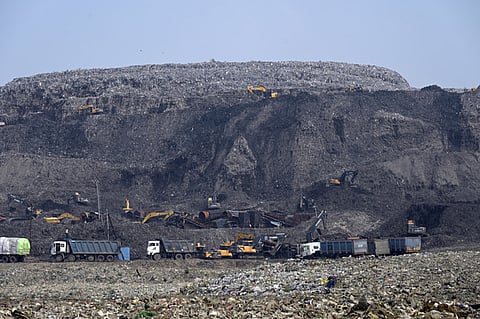
Delhi’s three landfills show the long-term consequences of failing to separate waste at source. Bhalswa, Ghazipur and Okhla are now being cleared through bio-mining, a process in which old waste is excavated and mechanically separated into recyclable material, inert soil-like material, combustible fractions and residual waste. Bio-mining is necessary because the city allowed mixed waste to accumulate for decades. What was not separated at the household level then must now be separated through expensive machinery.
The progress at these sites is uneven. Bhalswa has been almost completely bio-mined, with 96% remediation completed. Okhla has also made substantial progress, with 88% of its legacy waste processed. Ghazipur, however, remains the biggest challenge. Only 20% of its legacy waste has been processed, even though the site contains 140 lakh tonnes of old waste, almost half of Delhi’s total legacy waste burden.
Ghazipur is the clearest symbol of what happens when segregation fails for years on end. The mountain of waste there is not just a landfill problem. It is the physical record of a broken waste chain. Every mixed bin, every missed collection point and every weak enforcement drive has contributed to the burden now sitting at the edge of the city. Unless the city changes how waste is handled at the source, the landfills will continue to receive material that is difficult to process.
The way forward
The segregation challenge is not due to a lack of targets. The MCD has set a goal of achieving 100% source segregation by January 2027. It has identified 633 zero-waste colonies where segregation and in-house composting practices are being followed. These are important signs that the city understands the direction it must take. However, the challenge is to make such examples the norm rather than the exception. A few colonies or wards cannot solve an enitre city’s problem unless the model is scaled up across neighbourhoods, markets, institutions
and informal settlements. That will require stronger enforcement, better public participation, more reliable door-to-door collection and closer integration of informal workers, who already play a major role in recovering recyclable material from the waste stream.