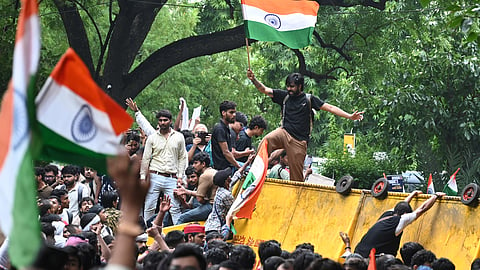

NEW DELHI: As the first light of dawn spread across the capital, a sea of young faces, mostly students, took over the streets leading to Jantar Mantar. It was far beyond a routine protest with supporters travelling overnight from Maharashtra, Punjab, Bihar, Uttar Pradesh, Gujarat and several other states. Many had arrived from abroad, united by a single demand—systemic education reforms.
In the foreground, voices overlapped as people argued, gestured, and shouted directions. Behind them, thousands watched, recorded videos, and waited. The crowd spilled beyond Jantar Mantar—Janpath, outer circle of Connaught Place had disappeared beneath a tide of people.
Many climbed ledges, shop roofs, and traffic barriers – anything that gave them a better view or allowed them to be counted. There was frustration, curiosity, and anger, yet the spirit of rebellion did not descend into disorder. Strangers shared water, helped one another navigate the crowd and guided the injured towards safer spaces. Supporters were distributing salt which would help them ease pain inflicted by the tear gas shells.
The crowd reflected the diversity of India’s youth—school students, college and university students, recent graduates, and aspirants. There was little to distinguish them by appearance. Most carried just a backpack, a water bottle, and a mobile phone. Some held handmade placards and posters. “The roads aren’t blocked today; they have been claimed. It must have been done earlier, and now there should be no backtracking from here,” said Gurveer, a young supporter from Chandigarh.
July 20—the date had dominated social media conversations for nearly two weeks. Slogans rolled across the crowd in waves, interrupted by the beats of dhols, applause, poetry and songs by Sidhu Moose Wala—“Sach bolega taan milu 295, je karega tarakki putt hate milugi…”—poems like “Mera desh jal raha hai…” and chants.It was not noise but collective presence.
Above Connaught Place, birds circled restlessly as if echoing the unease below. By evening, the same roads witnessed vandalism after tear gas shells were fired three times to disperse the crowd. The atmosphere shifted to chaos within minutes. Students were seen lying on the road after being hit by lathis and tear gas shells. Some struggled to breathe, their eyes watering and faces burning, while others refused to leave despite their injuries.
One 17-year-old student, Vivaan, sitting on the Janpath market footpath after being struck on the knee by a lathi, said, “I am still not going anywhere. If any drop of my blood can help the government bring any change in the education system, I will be happy. What is my fault?”
The day echoed a side of the city that has rarely surfaced in recent years.
City movements
Delhi has seen major protests in recent times that have impacted the politics of the country
2011: The India against Corruption movement, spearheaded by Anna Hazare, demands enactment of the Jan Lokpal Bill. It soon snowballs into a nationwide anti-corruption movement, drawing massive public support and eventually giving birth to a new political party, the Aam Aadmi Party.
2012: Following the horrific gang-rape in a moving bus, Jantar Mantar turns into a key site for candlelight vigils and demonstrations demanding justice and stricter laws. The 2012 Nirbhaya protests sees thousands of students, young professionals and citizens gather at India Gate, repeatedly attempt to march towards Parliament and Rashtrapati Bhavan. Water cannons, teargas and baton charges used to disperse the crowds.
2019-2020: The anti-CAA protests witness large demonstrations, student protest at Jamia Millia Islamia and the sit-in at Shaheen Bagh. Road closed, heavy police deployment and Metro station closures to stop protesters. In February 2020, the protests take a tragic turn when clashes between anti-CAA and pro-CAA groups in northeast Delhi spiral into communal violence, resulting in 53 deaths and over 500 injuries.
2020-2021: The year-long stir against the three farm laws turns Delhi borders into major protest sites, with thousands of farmers camping at Singhu, Tikri and Ghazipur demaning repeal of the three farm laws.
2023: In January, several Indian wrestlers, including Olympic medalists Vinesh Phogat, Sakshi Malik and Bajrang Punia, stage a sit-in at Jantar Mantar alleging sexual harassment by then Wrestling Federation of India (WFI) chief Brij Bhushan Sharan Singh. The protesters demands his arrest, a fair investigation and reforms in the federation.
