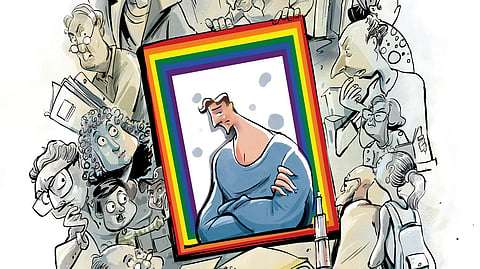

Somewhere between visibility and vulnerability, the transgender community is surviving the omnipresent gaze, negotiating dignity in everyday encounters, and navigating public spaces while carving out safe spaces that make them feel seen and heard despite tweaking legalities.
Bill or not, when everything is geared towards othering them, anxieties are rarely one dramatic outlet in isolation. Despite these anxieties, they find their niche corners to survive in a city that offers both anonymity and exposure.
Hums at the traffic
“Sometimes when we walk across the cars asking for money at the traffic stop points, we often encounter people who try to pull our hands or touch us inappropriately,” says Lakshmi, a 25-year-old trans person who resorts to begging at the traffic signal near Nizamuddin Dargah. Life is not the most usual for them. “I was 14 or 15 when I got to realise my identity, and since then nobody in my family apart from my mother has accepted me,” Lakshmi says, while adding that she currently lives with her mother.
When asked if she has access to any welfare schemes from the government, she denied it saying that she isn’t aware of any such schemes.
However, the Ministry of Social Justice and Empowerment has initiated shelter homes named ‘Garima Greh’ across the country for transgender persons. These shelter homes provide safe and secure shelter to transgender persons in need and also conduct capacity-building and skill development programmes for transgender persons. During the COVID lockdown period, a helpline was also set up to provide psychological support through trained psychologists to transgender persons in distress during the same time.
Recently, the Delhi government in its 2026 budget also introduced a new initiative will ensure free travel for transgender commuters in DTC and cluster buses. Additionally, under the ‘DURGA’ scheme (Driving Upliftment and Rozgar for Women/Transgender Green e-Auto), Rs 20 crore has been proposed to support 100 transgender persons and 100 women in getting e-auto permits through subsidies and interest subvention.

Understanding it medically
The queer community is often seen like an umbrella, where individuals with various gender identities unite. “Many individuals’ gender identity do not correspond to their sex assigned at birth. Hence with gender preference contrary to their reality, they often prefer undergoing gender reassignment surgeries,” said a medical professional who has been associated with sex change surgeries for several years now.
Talking about the process before the surgery, the professional who refused to be named said, “They have to go through sessions with psychiatrists, following which they are referred to endocrinologists, who prescribe them medications that help develop hormones of the gender that they want to change themselves to.
After this whole process, the surgery is performed as per the individual’s preference, and this is done by either urologists or plastic surgeons,” he explained. Even after the surgery, it takes almost two to three years for an individual to completely undergo gender change. Apart from this, many individuals want to live on the basis of self-identification, “where they declare their gender identity and do not wish to get any medical surgery done”, he added.
The most common terms in the language of psychiatry to define the issue are ‘gender identity crisis’ or ‘gender dysphoria’. Elaborating the concept, a Varanasi-based psychiatrist who deals with such cases on a regular basis said, “A gender identity crisis refers to a period of confusion about one’s gender identity. In contrast, gender dysphoria is a clinically recognised condition involving significant distress due to a mismatch between one’s gender identity and assigned sex at birth. While a crisis may be temporary, dysphoria often has deeper emotional and psychological impacts.”
He said the struggle comes when parents nag for medicines to cure what they believe is an illness. Eventually fewer than 5% of the patients actually stick to their choices. The common symptoms are headache, panic attacks and suicidal thoughts. “It is like a strong rejection for self because society and their family are constantly making them feel that they are wrong, against nature.” Almost all succumb to family pressure and get married the regular way, masking their preferences behind.
Judith Butler, an American feminist and queer philosopher , defines it as a “performative” act, where the repeated, social acts themselves constitute the reality of the gendered subject. She argues that there is no “true”, pre-existing gender identity inside us; rather, our outward performances create the illusion that there is an inner, stable gender, which in turn reinforces patriarchal, binary norms.
“Parents fail to understand the language of the soul, and as a result, individuals unlearn their feelings while many deal with these feelings alone for the longest period of time before they actually seek help,” the psychiatrist said.
Where you feel heard
Twelve years ago, when the city still spoke about the community in whispers, Vikas built a space along with Girjashanker for the queer community called Depot48 at Greater Kailash. It started as an independent live music venue and went on to be a quiet, compassionate meeting spot where one feels a sense of belongingness.
In a conversation with the newspaper, Vikas said, “A lot of people found love here; many of them even settled down. It is not just a space for community-building but also a support system.” They even came up with a hashtag for such couples’ called: #wemetatdepot.
Pronouns do not define the ones meeting at Depot, Vikas says; it’s a place where queer culture and counterculture have always belonged. The space has gender-neutral washrooms, and they host regular discussions and gig nights for people to meet and connect without judgement in the city.
In Delhi, acts of compassion from allies, acquaintances, or strangers can transform everyday experiences. They reduce anxiety not through grand gestures, but through small affirmations of dignity. The insistence on living authentically, despite everything, becomes a task for most until peer groups and places like Depot 48 or Kitty Su by The Lalit give them a home.
Samruddhi, aka Sarthak, who pursued her postgraduation from Delhi, resonated with the thought. Born in Bareilly, she realised that in the scenic garden of Sundar Nursery life isn’t a continuous act of negotiation. She said,
“We hosted potlucks and picnics in Humayun’s tomb and the Sundar nursery, and it was the best part of my college life. No raised eyebrows, no judgemental taunts, just solidarity, shared language, and a sense of being understood without explanation.
She also mentioned peer groups like Shringaar, where one finds their chosen families and community networks emerge as spaces of resilience.
Stories from the horizon
Growing up, Samruddhi always sensed a quiet difference within herself, that lacked language in a time when conversations around gender identity were limited. It was only during puberty that she confronted this reality embracing her identity as a woman. That acceptance marked the beginning of a journey away from angry parents, defined by resilience, self-assertion, and an unwavering refusal to step back. Born Sarthak, she is now in the preoperative stage.
Her time in Delhi reveals a complex relationship with public spaces such as the metro. While she lived openly as a trans woman, the visibility came with scrutiny. Lingering stares and subtle exclusion were part of her daily commute. “The security checks at metro stations initially carried discomfort, but I initiated small conversations, and gradually things normalised,” she said.
Familiar faces began to accept her, conversations replaced silence, and discomfort slowly gave way to recognition. But this fragile acceptance was often limited to familiarity. At new stations, the cycle of scrutiny would begin again, and the metro somehow became a site of vulnerability. She recounts instances of harassment, being touched inappropriately in crowded compartments. “Despite carrying pepper spray and other means of self-defence, in the chaos of public transport, the body freezes before it can react,” she said. The burden of navigating these spaces is like a constant struggle to find dignity and safety.
However, her workplace experience stands in contrast to the discrimination often associated with transgender identities. She speaks of an inclusive corporate culture, where diversity is not merely symbolic but practised. She identifies herself as India’s first transgender person to work in a collections department, a field that demands direct interaction with customers and involves the pressures of fieldwork. “Companies are increasingly recognising the need to move beyond confining LGBTQ+ employees to back-end or creative roles. I am a trans woman, and my company provides therapy reimbursements and surgery cost reimbursement.”
Despite all these, she seeks therapy to process the weight of the effort it takes to simply exist with dignity. For Samruddhi, therapy becomes both refuge and resistance, helping her unlearn internalised stigma and reclaim her sense of self.
Neela (name changed) from the Northeastern queer community in Delhi highlighted the fact that they face double discrimination. They suffer from the lack of professional help for therapy, crowdfunding to sustain their cause and, most importantly, space to breathe. She said that back home in Mizoram or Nagaland, people are more open, while Delhi gives them acceptance to a certain extent; the discrimination doesn’t seem to end.
“We had a way-forward social construct before their imposition of colonial gender rule and Manuvaad. Mainland becomes an act where dignity, autonomy and freedom of self-expression are like a forbidden apple,” she said. It’s not about policy gaps or social prejudice but about the everyday act of claiming space in a city that is still learning to listen.
Lives of the community unfold, neither fully excluded nor wholly embraced, and each step forward is hard-won. What emerges is not merely survival but life built through chosen kinships, fleeting solidarities, and moments of self-recognition.
The city, in turn, becomes a mirror—sometimes harsh, sometimes hopeful.