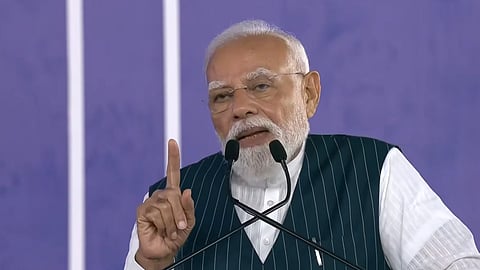

AHMEDABAD: India's semiconductor ambitions gathered fresh momentum on Friday as Prime Minister Narendra Modi inaugurated the Rs 7,600-crore CG Semi Outsourced Semiconductor Assembly and Test (OSAT) facility at Sanand in Gujarat.
The event marked the commercial launch of the country's third semiconductor manufacturing plant within just four months.
The inauguration is a major milestone under the India Semiconductor Mission, and it reinforces the Centre's push to establish India as a global semiconductor manufacturing destination.
Addressing a large gathering, Prime Minister Modi described the occasion as proof that India delivers on its long-term commitments.
"Five years ago, we resolved to make India a semiconductor hub under the vision of 'Make in India'. Today, commercial production has begun at the country's third semiconductor plant, turning that resolve into reality," he said.
Reflecting his interaction with employees at the facility, the Prime Minister said the project represented the spirit of the 'Mini India'.
"I met the engineers, technicians and young professionals working here. Their confidence, technological understanding and commitment deeply impressed me," Modi remarked.
Highlighting the scale of the project, PM Modi said the Sanand facility would initially manufacture nearly 20 crore semiconductor chips annually, with a long-term target of increasing production to 500 crore chips every year.
"I am confident that India will achieve the target sooner than expected," he asserted.
The Prime Minister also revealed that the inauguration fulfilled a vision he had pursued for more than two decades.
"Nearly 20 years ago, I had identified 350 to 400 acres of land near Gandhinagar and Prantij for a semiconductor project. Discussions were held with companies, but the proposal could not move forward due to circumstances prevailing at the Centre," he said.
"At a time when hardly anyone in India discussed semiconductors, it was my dream, and that dream has finally become a reality. This is a satisfying moment," Modi said.
Positioning Sanand as India's emerging technology powerhouse, the Prime Minister said industrial growth succeeds only when strong manufacturing clusters are created.
Drawing comparisons with global innovation centres, he said, "Every industrial superpower has developed through clusters. America has Silicon Valley. Sanand is moving in the same direction. One industry attracts another, creating an ecosystem that generates investment, innovation and employment."
He added that the semiconductor cluster taking shape in Sanand would attract companies across multiple sectors while creating lakhs of direct and indirect employment opportunities.
According to Modi, India's transformation in electronics manufacturing offers a blueprint for the semiconductor sector.
"We began with mobile phone manufacturing. Before 2014, India largely imported mobile phones. Today, India has become the world's second-largest mobile phone manufacturer, while electronics production has increased sevenfold. The next phase is to manufacture the semiconductor chips that power the global electronics industry," he said.
Emphasising self-reliance, Modi said India's vision extends far beyond establishing factories.
"Our objective is not merely to manufacture mobiles or electronic products. We want to produce the chips that power the entire electronics ecosystem. The next stage is to achieve self-reliance in critical minerals, advanced materials and the complete semiconductor value chain. This is the roadmap for a developed India," he said.
In a lighter moment during his address, Modi referred to the popular dialogue from the 'Panchayat' web series to underline his government's performance-driven approach.
"As the famous dialogue goes, Sun rahe ho, Binod… kaam bolta hai'. I believe in the same principle. Work speaks for itself. I never set small goals. Whether it is building the world's tallest statue or creating a global semiconductor ecosystem, our ambitions are always big," he said.
The Prime Minister said the proposed India Semiconductor Mission 2.0 would strengthen everything from chip design engineers and equipment manufacturers to logistics providers and material suppliers.
"As production expands, the domestic demand for semiconductor materials and components will create significant opportunities for the Indian industries and MSMEs," he added.
The CG Semi facility, approved by the Union Cabinet in February 2024 under the India Semiconductor Mission, has been established by CG Semi Pvt. Ltd., a subsidiary of CG Power and Industrial Solutions Ltd., with an investment of Rs 7,600 crore.
The project is among the first four semiconductor projects approved by the Centre and has been developed in partnership with Japan's Renesas Electronics and Thailand's Stars Microelectronics.
The collaboration is expected to strengthen India's semiconductor manufacturing capabilities while integrating the country into the global electronics supply chain.
Following the inauguration, Prime Minister Modi inspected various semiconductor manufacturing and packaging processes at the state-of-the-art OSAT facility.
The event was attended by Union Electronics and Information Technology Minister Ashwini Vaishnaw, Gujarat Chief Minister Bhupendra Patel, Minister of State Harsh Sanghavi, Science and Technology Minister Arjun Modhwadia and senior industry leaders, underlining the strategic importance of the project for both Gujarat and India's technology-driven economic future.
