
KOPPA: Decades ago, Koppa had meant punishment for his grandfather. For Rohan, it was a journey back to the town where his grandfather had worked, at
the turn of the 20th century.
It was a journey he had to take, the small town in Malnad district was
alive in his imagination — alive in the way his grandfather’s journal described
it.
Those days Koppa was the kaala paani, some place dark and distant,
where erring officials were transferred. Ramamurthy, Rohan’s grandfather,
was also transferred for some perceived wrongdoing.
Thappu maadidavarannu Koppakke Haaku (You make a mistake, you pay
for it in Koppa) was a popular saying of the era.
Even reaching there was a task. Ramamurthy had to get down at Kadur,
then the district headquarter, from a Bangalore-Shimoga train. He had reached the district office in a horse-driven cart in which the post bags were carried to Sringeri.
The tongas and bullock carts were the only means of transport available
to reach Koppa; it took 24 hours to get here from Bangalore.
In Koppa, it rained, and it rained hard. One of the first journal entries of Ramamurthy had read: “We have to only experience and understand how heavy the rain in Koppa is. Words are a poor medium to explain the rain here.”
Rohan’s grandfather had first stayed at the in the Musafir Khana constructed
by the traders from Kutch, Gujarat.
Koppa, till the early 1900s, was yet to become the bustling small town it
is today. Though it was declared as taluk headquarters in 1886, it had only
three government offices — Amaldar’s office, primary school and post office
for a long time.
It was not even a fully grown village. Houses were scattered sparsely in Kelaginapete and Melinapete.
And mosquitoes had evoked constant fears of malaria in Ramamurthy.
mind. The day used to get over early, streetlights had yet to make an appearance,
and roars of tigers had sent a chill down many a spine.
There were no doctors either. Once, when Ramaurthy had fever, all he
could get was a ayurvedic decoction made of pepper. Someone from the
Amaladar’s office had given quinine pills imported from Ceylon (Sri Lanka).
“We take these pills immediately, even though we are not sure whether
the fever is caused by malaria,” a friend had told Ramamurthy.
There were so many mosquitoes in the area that a village near Koppa was
rechristened Sollepura (village of mosquitoes).
The mosquito eradication programme was a failure. While the government
had supplied DDT, villagers refused to allow it to be sprayed in their houses — they feared the DDT would harm them.
People, who could afford, used to take the patients to Tirthahalli where
an ayurvedic doctor D’Souza used to treat them or to Kadur. For others, local quacks were enough.
Koppa of Ramamurthy’s time did not have a single hotel, and in his
words “coffee here tastes like another ‘kashaaya’ (decoction) made of roots
and herbs”.
Only the temples nearby, particularly the Sringeri Sharada Peet, had
kept Rohan’s grandfather moored; given him the strength to carry on. His ordeal, in Koppa, didn’t last long. After almost a year, his superiors
realised that Ramamurthy was not at fault and he was transferred back to
Bangalore.
For Rohan, though, Koppa remained the land of darkness located in the
Western Ghats.
On a lazy morning, he got out of the rickety KSRTC bus. He was finally in
Koppa, the place of his grandfather’s journal.
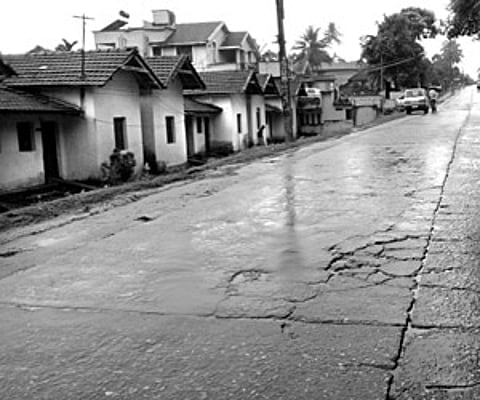
The place he was seeing was not what his grandfather had described.
The town was slowly waking up. Joggers were gracing the streets, there
was a wide concrete roads lined up with buildings — including hotels.
He asked a shopkeeper, “Is this Koppa of Kadur district?” “This is Koppa,
Chikmagalur district,” came the reply.
The shopkeeper said Kadur was no longer a district headquarter.
Then the shopkeeper told him a story. Koppa was exactly like Ramamurthy
had described — till 1920.
Things changed, when in 1920, M S Devegowda, an affluent person from
Makonahalli, Mudigere taluk, shifted to Koppa. An enterprising person, he
started Koppa Bank in 1920, which was liquidated after 20 years. Other things
soon followed. Devegowda started a private bus company in 1927, and 1931 donated a building to start the government hospital.
In 1934, he opened a petrol pump, and the first ever rice mill. of the district
in Koppa. In 1944, a government high school started with 15 students.
Kerosene lit street lights were introduced in 1927 and in 1957 Koppa got
electricity.
Today, Koppa with its pleasant weather is a place to enjoy. It has a
degree college, courts, offices, an ayurvedic college, an ITI, seven banks,
a coffee research station, and an office of the Spices Board.
The place has also given birth to freedom fighters. The place, where decades ago you couldn’t fine a good cup of coffee, now hosts many coffee estates.