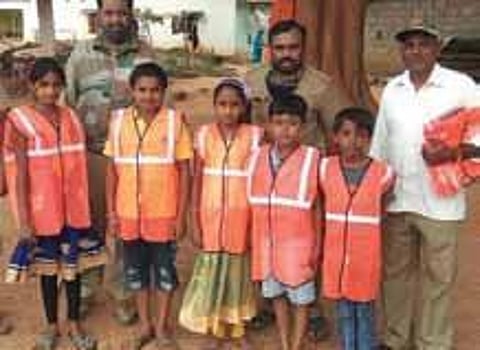

BENGALURU: If children and elderly people walk about in orange-coloured reflective jackets in Tumakuru district, there is a reason. This is the forest officials’ novel scheme to scare away the leopards. Young children have been victims of leopard attacks in towns and villages, frequented by these spotted big cats. In view of this continuing problem, 1,000 reflective jackets are being issued to children and the elderly in five affected taluks of the district. This distribution scheme is being taken up in the taluks of Kunigal, Gubbi, Tiptur, Turvukere and Tumakuru Rural that have been severely affected by the incursion of leopards in human settlements.
The leopards here usually inhabit rocky terrains and come out in search of stray dogs in villages. And many a time, children playing in the vicinity have become victims. For the leopards, kids look like small prey. Recently, a few children were attacked and this has spurred the district officials to launch this innovative scheme.
Speaking to TNIE, Girish, DCF Tumakuru, said, the orange-coloured jackets are made of synthetic material and are reflective. Girish added, “Young kids and old people who come for grazing in fields in some 24 villages are being provided these jackets which are reflective and scare away the leopards. We have involved the anganwadis and tied up with a clothing store to supply these jackets which are priced at `50 a piece.”
According to the DCF, when a person wears a reflective orange jacket, the leopard can clearly distinguish between humans and its natural prey. Many a time, the leopards attack children thinking it is a small prey like dogs. However, seeing the reflective radium lights, it will go back and it may not attack people.“This is a cost-effective technique taken up by Tumakuru Forest Division to tackle the problem of leopards frequently straying into villages. There are no forest lands in this district and most big cats have made their homes in rocky hills with the leopard population now touching almost 100-120,” he said.