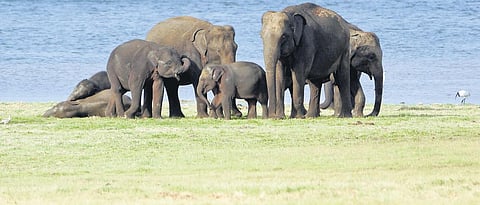

BENGALURU: Forest officials of all southern states went on foot to note details of all the elephants they sighted on Wednesday under the direct count method on the first day of the three-day elephant census.
Guards, rangers, and even directors of forests counted calves, juveniles, sub-adults, adults, and tuskers in all the areas where elephants are found.
This time, instead of identifying elephants by height, they used a more straightforward method for faster and easier assessment. “If the baby elephant is able to pass under the mother’s belly then it is listed as a calf, if it stands as tall as the mother’s legs it's a juvenile, if it reaches the mother’s shoulders it's a sub-adult, and above that it is an adult. All forest officials across southern states are using this method of assessment, ensuring uniformity,” said a senior forest department official from Karnataka.
The census is being done soon after the tiger census report was released. Forest department officials are clear that this exercise is not to check if the assessment done during the tiger census was right or wrong. “Officials of the National Tiger Conservation Authority (NTCA) opine that the count done then is sufficient. But that is not correct. All southern states decided to have a special synchronised assessment of elephants and it started from Wednesday,” the official said.
The method of assessment, however, is the same. The census and data collection were done beat-wise, where forests were divided into 5 sqkm beats. A team of not less than three were posted on each beat, to walk and count the number of elephants sighted under direct count. Each team was given a walkie-talkie, phone to note data, and a gun for safety. The teams consisted of trained staffers, who were part of the tiger census, and new recruits.
The census is being done in Karnataka, Tamil Nadu, Kerala, Goa, Andhra Pradesh, Telangana, and Maharashtra. In Karnataka, the assessment is being done even in territorial divisions and areas, like Hassan and Kodagu, where there are conflicts, officials said. In regions bordering human habitations, the assessment of direct count started from the border areas, where the location of the sighting and its distance from borders, inside and outside the forests, was also accounted for while marking the locations.
“In the last census in 2017, over 6,000 elephants were counted. Since a calf is born every two years and cases of conflict have reduced and there has been no poaching, we hope that the count will increase. We also hope for a higher count in Kali Tiger Reserve, despite the connectivity to other forests in Anshi and Dandeli being broken because of the construction of dams. We expect the count to go up to at least 60 from 40, apart from spillover elephants to Goa and Maharashtra,” the official added.
A jumbo exercise
1st day (May 17) is block count & direct count of elephants
2nd day (May 18) is line transect, indirect count of elephant dung
3rd day (May 19) is waterhole count of elephant, to know the demography
