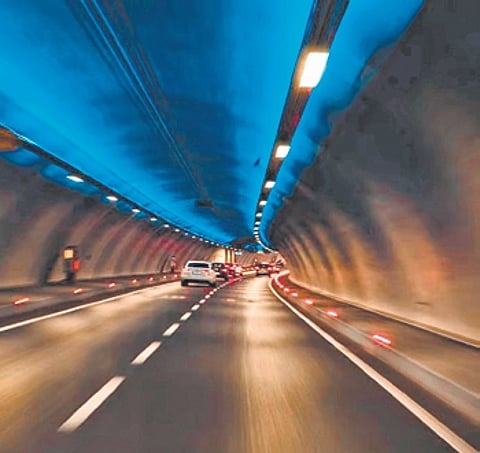

BENGALURU: While the state cabinet has granted administrative approval to the ambitious 18.5-km tunnel road project linking Esteem Mall in Hebbal with Silk Board Junction in South-East Bengaluru, experts have red-flagged it, raising concerns.
They have said that despite the project’s feasibility, it’ll come with many challenges to deal with, besides the Rs 12,690 crore investment will outweigh the benefits.
Dr D Paramesha Naik, Professor, Department of Environmental Science, Bangalore University, expressed his reservations over the project. He pointed out that the project could face problems with geological complexities with hard rocks and fissures, making tunneling difficult and expensive; major disruptions in water table, affecting nearby water sources and structures; Bengaluru’s soil being prone to settlement and instability, potentially affecting tunnel structural integrity; special design considerations for tunnel stability; and environmental concerns as tunneling can impact nearby ecosystems, water bodies, and air quality.
It was precisely due to these challenges and the high costs that the idea of having a Metro Rail network completely underground in Bengaluru was not taken.
Vehicular traffic, unlike Metro Rail’s movement, is highly erratic, posing a high risk. “Rockfalls or tunnel collapses, gas leaks or explosions, flooding or water ingress, and fire risks from equipment or materials are the challenges in the tunnel project,” he said.
Former professor of Geology and Coordinator Bio Park of Bangalore University Renuka Prasad said Bengaluru in recent years has witnessed tremendous vertical growth with building foundations and metro pillars going deeper underground. There are lakhs of borewells that are dug deeper and many apartments have multi-level basement parking. All these structures might be affected due to the tunnel road project. He also pointed out that tunnels will hamper groundwater flow and cause shortage of drinking water.
‘Green cover may be affected due to tunnel road infra’
“Although the city is sitting on hard rock terrain, let’s not forget it’s a thin layer compared to the earth’s radius. Geologists identify it as a tunic or skin of an onion’s outer cover. Earth is also highly dynamic in nature, a lot of readjustments due to plate tectonics create huge changes in this thin layer,” he said, adding that this can cause fractures, faults and folds which could bring down the stability of the tunnels, posing a grave threat to the users.
“Disturbance and re-adjustment of the earth’s crustal zone is a natural system. However, the disturbances triggered by man-made activities like the tunnel road project are completely avoidable,” he said.
On the environment front, he pointed out, “The forest cover in Karnataka is below the mandatory requirement of 33%, and the city has only 5%. The green cover may be affected due to the project infrastructure. The primary drainage system is already compromised and the remaining stormwater drains are shrunk due to encroachments. Rock quarrying is rampant around the city. The tunnel construction will lead to forcible destruction of the remaining green cover and drainage system, leading to further reduction in rainwater absorption capabilities, causing flooding in the city. Therefore, the geographical set up of the green, cool garden city will lose its sanctity,” Prasad said, adding there is also a possibility of landslides and sinkholes occurring.
Like Prof Naik, Prasad too said the plan of taking the metro completely underground was not taken up bearing in mind the geological, hydrogeological set-up and high costs, and said the tunnel project must be shelved.
The experts have instead batted for sustainable solutions to address traffic issues by optimising existing infrastructure, improving public transport and promoting sustainable urban planning more effectively.
DEPUTY CHIEF MINISTER
DK Shivakumar, who is also Bengaluru Development Minister, had proposed a network of underground road tunnels running 191km and connecting 11 high-density corridors in Bengaluru, costing upwards of Rs 30,000 crore, to be implemented in phases. The first among them, the 18.5-km tunnel road from Esteem Mall near Hebbal Flyover to Central Silk Board Junction, will be implemented in the first phase, and was approved by the state cabinet on August 22. Experts, however, are concerned over its impacts. TNIE in a three part series, beginning today, will look at the implications of this project that has received much criticism.
MAJOR CHALLENGES FOR TUNNEL ROAD PROJECT:
Geological complexities: Bengaluru’s geology is challenging, with hard rocks, fissures, and water tables, making tunnelling difficult and expensive.
Water table and groundwater: Tunneling could disrupt groundwater flow, affecting nearby water sources and structures.
Soil stability: Bengaluru’s soils are prone to settlement and instability, potentially affecting tunnel structural integrity.
Environmental concerns: Tunneling can impact nearby ecosystems, water bodies and air quality.
Cost and feasibility: Tunnel roads are expensive, and costs may outweigh benefits.
