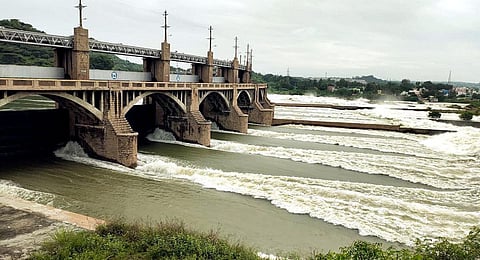

BENGALURU: With summer approaching, one of the biggest concerns that bothers Bengalureans is the drinking water crisis. While Bangalore Water Supply and Sewerage Board (BWSSB) officials are confident of tiding over any crisis in the present condition, they are worried that if there is an order to release Cauvery water for standing crops in Karnataka and Tamil Nadu in April and May, the board will have a tough challenge meeting the drinking water needs of the city.
Echoing the concern for April, a senior BWSSB official said they have appealed to Cauvery Neeravari Nigam Limited through two representations, to reserve 2.42 tmcft water for April and May, which is peak summer.
Amid these challenges, the water board will launch a ‘Save Water’ campaign in all media, appealing to citizens to use water judiciously, and not use running or flowing water for washing vehicles.
BWSSB Engineer-in-Chief B Suresh said, “At present, there is stock of 28 tmcft (thousand million cubic feet) water in Krishna Raja Sagar (KRS) and Kabini dams. Bengaluru city requires 1.6 tmcft of water per month, and if we go by that calculation, we may require about 11 to 12 tmcft of drinking water.”
Apart from giving permission for over 2 lakh borewells for residents in the past, the Board is also taking care of water supply from 12,000 public borewells that were transferred from Bruhat Bengaluru Mahanagara Palike in 2015. “Some houses get piped Cauvery water and some days, they draw water from public borewells which not every resident has a connection to. Local engineers don’t do much as there is political interference,” said a resident.
110 villages yet to get Cauvery water
An official said the board is speeding up its Cauvery Stage V and once commissioned, the 110 villages merged from Yelahanka, Byatarayanapura, Bommanahalli, RR Nagar and Mahadevapura will also get piped Cauvery water.
“At present, water is supplied through big tankers to these areas,” said the official. He added that the Rs 5,500 crore work in TK Halli pumping station, connecting Vajarahalli in South Bengaluru to TK Halli pumping station in Northeast Bengaluru is almost complete. Water will be stored in three groundwater reservoirs between TK Halli pumping station connecting to Vajarahalli, and four ground water level reservoirs between TK Halli pumping station. “A total of 775 million litres of water per day will be supplied to 110 villages merged into BBMP, once it is commissioned in May,” said an official.
However, residents of Mahadevapura zone, which is the tail-end of Bengaluru, often complain about scarce water supply, despite having a Cauvery connection in some parts, and hope that once Stage V is complete, they get enough water for their drinking water needs.
The water crisis has become acute in and around Whitefield, with ward committee proceedings being dominated by dried public borewells, and the consequent disruption of water supply to thousands of homes. The root cause for this is the blatant exploitation of groundwater for construction purposes by some builders, opined Sandeep Anirudhan, convener, Coalition for Water Security. “In the larger scheme of things, we need to seriously attempt to address the requirement for local water security,” he says. As water needs in outer Bengaluru shoot up in summer, tanker owners have the last laugh. The price of a tanker load of 12,000 litres is priced at Rs 1,500, while 7,000 litres costs Rs 900.
