
BENGALURU: Everyone has heard and read mythological tales of Ashwamedha Yagas, where a ruler would set his horse free to wander and if it was captured by any king there would be war. Many believe it to be just a tale.
But here is a coin to show and prove that such events did occur. The Ashwamedha gold dinara coin was minted during the Samudra Gupta period (334-370 CE). It has a writing in Brahmi script and depicts the queen -- Dattadevi -- wife of Samudra Gupta, as a goddess, standing on a lotus shaped pedestal on one side and on a sacrificial horse with all its four limbs on the other side.
Archie Maru, a numismatist and member of the Karnataka Numismatic Society (KNS), said that generally, writings on coins start from the 8 o’clock position. But on this coin, it starts from the 6 o’clock position. This is the first time that the coin is on display. The Gupta period from 320-550 CE is called the golden era and the coin shows just that, he said.
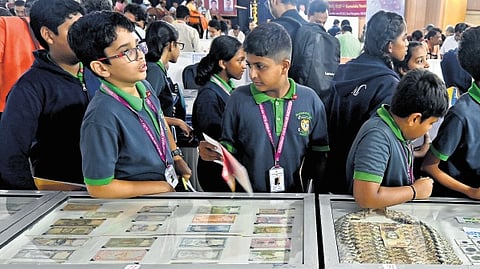
It is on display at the Nanya Darshini- 2024 exhibition of rare coins, stamps, currency notes and heritage items, organised by KNS.
The exhibition also displays the silver bent bar coin of the Gandhar dynasty, which ruled from 600 BCE to 300 CE. “This is known as the first Indian coin, minted at Gandhara Janapada, the present day Kandahar in Afghanistan. The coin has no script. It has two floral prints and experts are still trying to ascertain what they mean,” he added.
These are not the only unique displays at the exhibition. One can see the famous heritage Black Penny stamp, which is the world’s first postage stamp issued on May 1, 1840. There is also a four-anna Queen Victoria stamp released by the East India Company in India in 1854 and the world’s only seven-digit currency note of 1917.
To catch the attention of youngsters, there are revolving coins, one honouring the Indian cricket team, coins dedicated to Panchatantra tales, Hollywood movies and famous movie characters. There are also old artifacts on display and sale including vintage pocket watches, dinner table sets, stamps and currency notes from across the globe.
Fake stamps, coins common now
Bengaluru: Numismatic exhibitions are good learning grounds for citizens, especially children and youth. These events are needed to prevent fake and artificial items penetrating the circles, said Rajendra Maru, president, Karnataka Numismatic Society (KNS). Speaking on the sidelines at the inauguration of the three-day numismatic exhibition - Nanya Darshini-2024, organised by KNS, he said that most collectors are aged between 50 and 85, and there are hardly any young collectors now.
Such exhibitions help bridge the age and experience gap and also educate people on how to identify genuine and fake items, he added. Fakes are increasingly being found not just in new collections, but old ones too. Detailed security checks are needed when purchasing and selling items. As the number of collectors is decreasing, the penetration of illegal items has gone up as they are cheap and can be passed off easily, he said. KNS is one of the oldest societies of India with the highest number of 1,300 members.
The country has 10 registered societies and eight auction houses. At the exhibition, the youngest numismatist was 10 years old, while the oldest was 84. Lavith Nella, a Grade 7 student from Sudarshan Vidya Mandir, said he liked the coins of Tughlaq dynasty as they are reading about it in their history class. His friend D Sai Valli said she liked the Pandya dynasty coins as that is also a part of their syllabus.