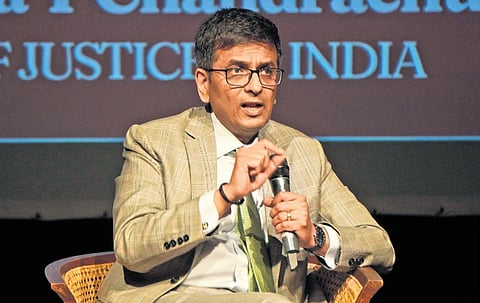

BENGALURU: Trial courts need to be encouraged to be more receptive to accommodating the concerns of people seeking liberty. Today, trial court judges are “playing it safe by not granting bail in very important issues or very serious crimes”, said Chief Justice of India DY Chandrachud here on Sunday. But judges should perform their duties without “feeling disgusted, or that my career will be on the line because of this case”, he advised.
He said, “Increasingly, we are seeing in a lot of cases, not just highly politicised and big-ticket ones, but also simple cases, where people who should be getting bail in trial and high courts are not getting it. As a result, they have to increasingly move higher courts.”
He was speaking at the 11th Annual Conference of the Berkeley Centre on Comparative Equality and Anti-Discrimination Law hosted by the National Law School of India University (NLSIU).
He said the number of small cases placed before the Supreme Court is large, and the number of bail applications judges clear outnumbers other matters. “We prioritise bail even during the vacations, for the simple reason that these people, at least, must have their day in court,” he said.
Focus on climate policies and use of tech
Delivering the keynote address on ‘Is there hope for equality law?’, the CJI spoke about the different kinds of discrimination and oppression that further divide communities and access to their fundamental rights.
On the need for equitable climate policies, he said, “Climate change amplifies existing inequalities, turning them into human rights issues that particularly affect those whose rights are already compromised. Women, children, disabled and indigenous people face heightened risks. Inequality thus becomes both a cause and consequence of climate change.”
He said a critical intersectional perspective is required that will provide a deeper understanding of climate change and develop more effective and equitable strategies.
On the need to use technology wisely for the welfare of societies, he said, “Transparency is key. We must ensure that how technologies and policies are developed and implemented is clear and accessible. Transparent systems and processes promote accountability and prevent misuse, aligning innovations with societal values and legal standards.”
