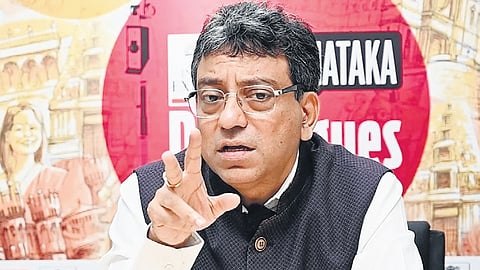

Infrastructure bottlenecks and governance gridlocks hobble Bengaluru’s long, arduous trek to be a nerve centre of creativity and the beating heart of modern India. The city needs pace; it also needs peace. Additional Chief Secretary Tushar Girinath, a technocrat who has seen from close quarters the rapid growth of the megapolis, in an interaction with TNIE says, contrary to widespread criticism, the tunnel road project connecting Hebbal to Central Silk Board is an idea whose time has come, while putting a plethora of administrative challenges in perspective. Excerpts:
There’s criticism that the government is rushing the tunnel road project without proper consultation. Why the hurry?
There’s no hurry. Bengaluru’s roads are choking. The average speed across the city has dropped to what experts classify as Grade F — the worst possible level. Whether it’s elevated corridors or tunnel roads, both are on the table because the number of vehicles almost equals our population. Any project, whichever one you pick, will take four to five years to materialise. Of course, every big project will have pros and cons. But this isn’t being done in a vacuum. We’ve worked with mobility experts, followed the prescribed circulation studies, and consulted plans before moving ahead.
Have scientific studies been done before pushing the tunnel road project?
Yes, studies have been done, including soil studies and detailed traffic assessments. Since this is a toll-based project, financial projections had to be worked out carefully. We’re using a modified BOOT (Build, Own, Operate, Transfer) model, where the private party invests its own money upfront and recovers it through toll collection. The government only provides the Viability Gap Support. While some say we’re hurrying, within the government, there’s concern that we’ve taken too long, that there’s been too much back-and-forth and too little movement.
Several studies, including one by the Indian Institute of Science (IISc), suggest tunnel roads could be a disaster for Bengaluru.
That study is not the official view of IISc. It’s the opinion of one professor. IISc professors work independently, and they’re free to share their thoughts. If someone points out a mistake, we’re ready to look into it and make changes. But just saying “don’t do this” without giving any workable solution doesn’t help. Take elevated roads — they sound good in theory. Even I was in favour of them earlier. But our roads are narrow and uneven — they go from four lanes to three in many places. If we start building pillars there, traffic will come to a total stop. That’s why we’re looking at tunnel roads only in the most congested spots. Yes, some underpasses in the world don’t work well — but many do.
The cabinet passed the Greater Bengaluru Governance Bill. What is the process ahead?
As of today, as per a notification issued by the state government, the Greater Bengaluru Area will be the same as the area governed by Bruhat Bengaluru Mahanagara Palike (BBMP); this does not mean that areas beyond BBMP boundaries will not be included further. The next step is dividing this area into city corporations. There was an issue over the number of parts the city will be divided into. We had a committee that was involved in the making of this bill; according to their recommendations, we have submitted a draft on a public domain. Objections are invited till August 18. Once that has been finalised – the target for which is September 2 – the five city corporations will come into existence immediately. Instead of a BBMP Chief Commissioner, there will be city corporation commissioners. Since elections are due, administrators will be appointed in the meantime. The position of the BBMP Chief Commissioner will change into Chief Commissioner of Greater Bengaluru Authority (GBA), which commences operations from September 2 (tentatively).
Is there a need for a GBA?
The GBA has been envisaged to divide authority amongst city corporations and ensure coordination amongst them and with various parastatals like Bangalore Electricity Supply Company Limited (Bescom), Bangalore Water Supply and Sewage Board (BWSSB) and others. Without this body, this would be a failed experiment. Every parastatal will go through internal changes in order to better respond to the city corporations: for instance, every parastatal will have a sub-parastatal for a specific city corporation. The state government will be overseeing the GBA, along with MLAs and representatives from the parastatals, with the body comprising 70-75 members. The GBA will not usurp the power of the city corporations, which derives it from the 74th Constitutional Amendment Act. It will, however, ensure smoothness and cooperation.
What about potential disparity in resources amongst the city corporations?
Each city corporation will be in full control of its resources. Weaker city corporations in terms of resource mobilisation will have their inadequacies met by the state government. The State Finance Commission will decide and approximate cases of redundant expenditure or potential deficits in city corporations, and the state government shall compensate in cases of genuine deficit.
What will be the frequency of evaluations conducted by the State Finance Commission?
Once in five years. We find it inevitable that there will be some disparity in terms of resources among the city corporations.
When will elections for these corporations be held?
As per the affidavit submitted to the Supreme Court by the state government, the period from September 2 to November 2 will be utilised by a delimitation committee for ascertaining the number of wards under each city corporation. Once that is completed, a voter list will be prepared by the State Election Commission, which might take 60-90 days approximately. The voter list should ideally be complete sometime in January 2026. After that, the notification will be issued to hold elections and the process takes another 45-60 days.
Last time there was delimitation, under the previous government, the number of wards was increased from 198 to 243, and the opposition party then (Congress) claimed the ruling party was acting in its own interests. The opposition party right now is claiming the same about the current delimitation. How do you respond?
The Supreme Court ruled in favour of the previous delimitation commission. Later, the number of wards was reduced to 225 under the advice of the delimitation commission, and the Supreme Court favoured that as well. This commission will be a separate entity from the government, despite having government officers. Let us believe in them.
How will the GBA make life better for ordinary Bengalureans?
The whole idea is to bring governance closer to the individual. Once the five corporations are created, for every individual, the governing body will move closer to them. Currently, there is one corporator for around 70,000 people, which is very difficult and overwhelming to be governed by one single entity. The city has grown rapidly and disproportionately since the 2011 census. There will be a substantial reduction in workload (when it is distributed). When smaller corporations are built to cater to grassroots needs, issues and resolutions become more transparent, and governance improves automatically. This won’t come cheap: there will be expenditure, because we will have to employ and deploy personnel for hands-on resolution.
All these years, the BBMP Commissioner or Mayor addressed the problems. Now, the CM will be heading the GBA. Will he be addressing the issues?
No, all functions of the BBMP have been transferred to the city corporations. The GBA has only a limited role, mainly coordination. Municipalities can also voluntarily involve the GBA by pooling their funds, but the GBA cannot demand money or start projects on its own. It is a misconception to think the GBA runs the administration. GBA has some roles. If the state government provides a developmental grant, it will be routed through the GBA, which will know how much is being allocated for water supply, electricity and other projects. GBA prioritises projects that are most needed. Large infrastructure works that city corporations cannot execute on their own will be decided at this level. Smaller works within the city’s own resources will not need state approval. Another aspect is GBA handles administrative functions that belong to the state government, not city corporations. GBA’s role is to function as the Local Planning Authority (LPA), which is slightly under debate. Under the Karnataka Town and Country Planning Act, the BDA is currently the LPA. But BDA is not directly accountable to citizens. Under the new system, the GBA will act as the LPA for its area, with technical support from BDA. The GBA will approve the master plan, invite public objections, and finalise it. This shift brings planning closer to the local level, increasing accountability for illegal layouts and violations.
Considering that you’ve headed BBMP, worked with BWSSB, and now serve as ACS, you’re no stranger to coordination issues. What directions will you give?
To address the very lack of coordination, we have two levels involved in coordination. Top level: chief secretary and additional chief secretary head meetings of all agencies operating in Bengaluru. At the constituency level, a coordination and advisory committee includes the MLA, MLC, divisional engineers, and ward members. This is not a supervisory body — it resolves local execution issues, such as road cutting or agency permissions.
Isn’t it taking away the powers of corporators and giving them to MLAs?
The inclusion of MLAs doesn’t take away corporators’ powers but adds broader vision. While corporators focus on ward-level issues, MLAs address constituency-wide concerns and ensure coordination between agencies. Ward committees will have elected representatives plus seven nominated members chosen by lottery. The corporator, as chairperson, holds veto power to overrule decisions, but must record reasons. This ensures balanced representation while keeping final accountability with the elected representative.
Cities in Karnataka, outside of Bengaluru, are also starting to face urban infrastructure issues. What should they learn from Bengaluru’s experience?
Good town planning is the backbone of a liveable city. If you delay planning or ignore fast-growing areas just because they lie outside city limits, you’re setting yourself up for bigger problems. That’s what happened in Bengaluru. Many areas like Mahadevapura grew rapidly because they were outside BBMP limits for too long. By the time they were brought under the city administration, they had already developed haphazardly and without proper roads, traffic plans, or building rules. Once people move in and build, it’s too late to enforce any real order. Whether it’s an industrial area or a residential zone, the traffic layout must be part of the original plan. And that’s why making and implementing a proper master plan early, by the same local authority that will enforce it, is absolutely essential. Without it, cities will face the same gridlock Bengaluru is dealing with today.
