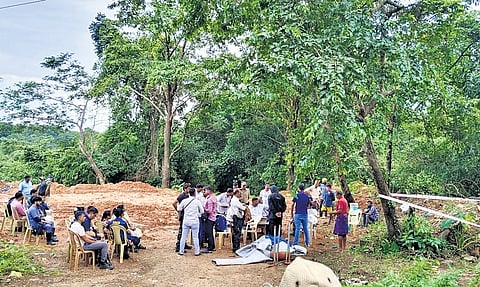

A former sanitation worker, who has emerged as a key whistleblower in the Dharmasthala mass burial case, has alleged to India Today that he and a small team buried scores of unidentified bodies in forested areas and riverbanks over nearly two decades, under instructions from the temple administration. The fresh allegations have not been independently verified by TNIE. This report draws on India Today’s interview with the whistleblower and previously reported information.
The whistleblower named four others as part of his burial team and claimed that there were no graveyards used for these burials. “We used to bury bodies in forests, on old roads, even near riverbanks,” he said, describing a woman buried on Bahubali Hills and around 70 bodies at the Netravathi bathing ghat. He once again highlighted one site, referred to as Spot 13, which allegedly held 70 to 80 bodies. According to him, locals sometimes saw these burials but never intervened. “People saw us, but they were least bothered. We used to get orders, we buried the bodies. That was our job,” he said.
While the whistleblower said he could not confirm the causes of death, he alleged that many bodies bore visible marks of violence and possible sexual assault. “Some had clear marks. It looked like they were assaulted,” he told India Today, clarifying that only a medical expert could confirm sexual assault.
He added that the bodies ranged in age from children to the elderly, with a disproportionate number of women, around 90 out of every 100 bodies he claims to have buried.
He told India Today that some burial sites may have been lost over the years due to erosion, forest growth, and construction work. “Earlier there was an old road we could identify, but after JCB work, we can’t locate some spots. The forest was sparse then; now it’s thick,” he said.
So far, the Special Investigation Team (SIT) has recovered partial skeletal remains from 13 sites identified by the whistleblower, including one belonging to a male. Addressing skepticism over the number of bodies recovered, he said, “Let people say what they want. We are the ones who buried them, and we are telling the truth.”
While expressing trust in the SIT, the whistleblower admitted to frustration over the investigation process. “I believe in the SIT, but it doesn’t seem to believe in me. I’ve come to show them the burial spots, relying on my memory, but the soil and land have changed so much over the years. I’m doing my best to point out the exact locations, and the JCB should dig wider to help recover the remains,” he told India Today.
He said four to five more spots remain to be searched, including Spot 13. “Let the SIT call the others who were with me. Everyone should speak the truth. If everyone is called, the process will be easier and faster,” he added.
The whistleblower also spoke about the 2012 murder of 17-year-old Sowjanya, whose body was found near Dharmasthala. He said he was on leave that night and claimed that he received calls from temple authorities about his whereabouts. “I got a call asking where I was the night she was murdered. I said I was in my hometown on leave. They shouted at me for being on leave. The next day, I saw the murdered girl’s body,” he recalled to India Today.
The man said he returned to Dharmasthala after two decades to seek personal closure. “I used to dream of skeletal remains. I felt guilty, so I came back,” he said, explaining that the burden of having buried so many unidentified bodies had haunted him. He emphasized that his intention is solely to locate and ensure final rites for the bodies, not to malign the temple. “I want to show wherever the bodies are buried. I have no reason to run. I want to finish this and return to my family,” he said.
He also denied allegations of stealing from the corpses or attempting to malign the temple. “If I had to live by stealing, why would I work and serve the temple? I’m Hindu, from a Scheduled Caste,” he told India Today.
The Dharmasthala mass burial case came to public attention in July 2025 when allegations surfaced that more than 100 bodies, mostly women and minors, had been buried in and around temple premises between 1995 and 2014. The Karnataka government formed a Special Investigation Team (SIT) to probe the case. So far, 13–15 suspected burial sites have been exhumed, many in forested or undeveloped areas that have undergone significant changes over the years, complicating recovery efforts.
