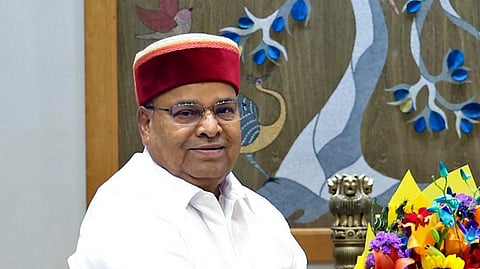

BENGALURU: Bengaluru Town Hall, a citizens’ collective on Monday urged Governor Thaawarchand Gehlot to withhold assent to the Karnataka Tank Conservation and Development Authority (KTCDA) Amendment Bill 2025, citing constitutional violations and environmental concerns.
In a memorandum submitted to the Governor, the collective highlighted that the Bill reduces lake buffer zones to a mere 30 metres, a move they said would endanger Bengaluru’s water security and ecosystem integrity.
Speaking at a press conference after submitting the petition, actor, director and activist Prakash Belawadi said, “Reducing buffer zones around Bengaluru’s lakes threatens the city’s traditional water system. Unlike river-fed cities, Bengaluru relied on a cascading network of lakes, where rainwater flowed from smaller tanks into larger ones through rajakaluves (stormwater canals).”
“When these canals are blocked and construction is allowed just five metres from lakes, natural drainage collapses, leading to flooding. Restoring and protecting rajakaluves would allow lakes to recharge naturally. Ignoring these traditional systems destroys water security and invites repeated urban flooding,” he added.
Highlighting the constitutional violations Sandeep Anirudhan, Convenor, Citizens’ Agenda for Bengaluru, said, “The bill has numerous constitutional violations. The Right to Life itself is being affected. The basic requirement for life is water. If something affects water, it directly affects the Right to Life.”
“Under our Fundamental Duties, the protection of the environment is not only a right but also a duty. And this duty is not just for citizens, it is equally for government officials, politicians, and the government itself,” he added.
The collective also added that on August 17, hundreds of citizens had gathered at Freedom Park under the ‘Save Our Lakes’ campaign to protest against the proposed amendment.
It may be recalled that hydrology and environment experts at a public consultation organised by Bengaluru Town Hall on August 9, had advocated for 100-300 m buffer zones to preserve ecosystem integrity, biodiversity, flood control, and water quality.
