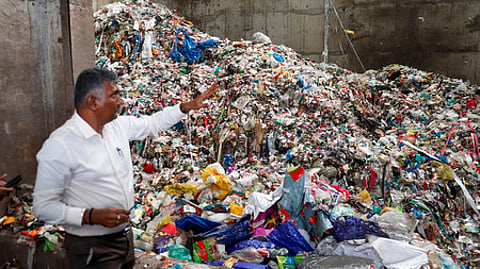

On Thursday, Bengaluru Solid Waste Management Limited (BSWML), the state government-owned company to execute solid waste management across Bengaluru, initiated an exercise aimed at knocking some sense into undisciplined citizens rampantly discarding garbage in public spaces. It has not just started levying fines of Rs 5,000 on each violator, but has also undertaken a more stringent measure of sending tractor-loads of garbage to be dumped in front of the violators’ houses. Civic officials are asked to do that while collecting the transportation costs from violators for dumping the garbage at their own doorsteps.
These measures are expected to drive fear into the minds of people to deter them from throwing garbage in public spaces or vacant plots. In many cases, a fine of Rs 5,000 may not pose as deterrence, but to face the embarrassment of garbage being dumped in front of one’s own house may instil a fear and discourage them from repeating the offence. It is like holding up the violators by the scruff of their necks to show them off to the civic society and say “Look! Here is the one who dirties our city!” It is hoped that fear is seeded in the minds of the violators, who may never again discard garbage irresponsibly. At least, BSWML seems to think that way.
But is that the right way to go about ensuring that people behave responsibly?
Will that help bring about a mindset change among people to keep our public environs clean? What is the guarantee that some time in the future when these measures are lifted, people won’t return to throwing garbage in public spaces?
Besides, BSWML is itself contributing to dumping garbage in front of people’s houses – the very act that it is trying to stop! So, there is hypocrisy in this comically childish measure that seeks to drive fear into the minds of people to stop them from dumping garbage.
Basically, such measures ‘impose’ cleanliness. But the imposition is without citizens’ understanding. They will refrain from dumping garbage, but it’s a reactive behaviour based on fear, not a proactive one based on mature civic understanding. The latter comes through awareness about the negatives of dumping garbage carelessly. It comes through knowing its adverse impacts.
The state government and BSWML need to know that every individual has cleanliness at the core. That’s why most people keep their own homes/offices, their own bodies, the food they eat, the water they drink, the clothes they wear, and their own vehicles, clean. But when it comes to public spaces, the core need for cleanliness – which they apply within their own homes/offices – seems to vanish, as if a magic wand was waved to make it disappear. This is a starkly selfish behaviour that makes them keep their own personal environs clean and safe, while caring two hoots for others! It is this selfish behaviour that needs to be tackled.
It needs to be remembered that public spaces are extensions of our own homes that we so care about. Citizens leave their homes to move about the city, only to return home. They need to understand that when they do that, they expose themselves to the ill-effects of the very garbage in public places which they themselves have thrown.
They need to wake up to the fact that garbage harms health by spreading infectious diseases. Mosquitoes, rats, flies, and other pests breed in waste. It causes respiratory problems, contaminates water and soil with chemicals, and poses direct risks of cuts, infections, heavy metal poisoning if they come in contact with them, leading to allergies, cancers, birth defects and chronic illnesses.
It facilitates vector breeding as they are the perfect breeding grounds for pests to spread diseases like malaria, dengue, cholera, typhoid and leptospirosis (rat fever) – a highly infectious disease with epidemic potential, caused by a bacterium called Leptospira, mainly carried by rats, who in turn thrive on garbage.
When we move out of our homes through public spaces, we unknowingly carry the effects of garbage back to our own homes. Therefore, our homes are not separated from the public spaces. We connect them, making our own loved ones vulnerable to the adverse impacts of garbage that we ourselves contribute to public spaces through irresponsible civic behaviour.
Realisation needs to dawn that teaching people “a lesson” through fear is never a dependable measure for long-term solutions; teaching people – through awareness – is. And that goes a long way to keep our cities clean…without fear, but with love for our cities and concern for our own safety.
