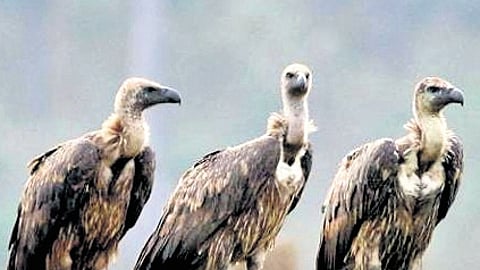

BENGALURU: Though there is a rise in vulture population across India, a breeding and rescue centre to conserve the birds is yet to start operations in Karnataka. To ascertain their natural population and breeding and roosting centres, a detailed all-India vulture estimation exercise will be conducted in 2026.
In Karnataka, experts and forest department officials have noted a rise in vulture numbers, particularly in Ramadevarabetta Vulture Sanctuary—India’s first vulture sanctuary, declared in 2012—located in Ramanagara.
“We have identified three Long-Billed Vultures (LBVs) roosting in the hillocks. Also, we have been sighting hatchlings for the last three years. But they are not roosting here. We are yet to record whether they return to the hills as adults or not. Reports of vulture sightings, including LBV, are also now reported from Savanadurga and Acchalu Hills in Kanakapura,” said Deputy Conservator of Forests, Ramanagara Division, M Ramahrishnappa.
Conservationists are putting efforts into protecting LBVs from the brink of extinction. Foresters and experts have also documented four Egyptian Vultures (EV) and White-Backed Vultures (WBV), along with the sighting of four migratory Himalayan Griffon and Eurasian Vultures in the last three years in Ramanagara.
“The government is not serious in starting the Vulture Breeding and Rescue Centre in Bannerghatta National Park. It was a 2020 budget announcement, and Rs 2 crore was set aside. The location was also shifted from Ramanagara to Bannerghatta for political reasons. Construction is complete, but operations are yet to start.
Supreme Court approval is pending, as the centre has been established in a national park without prior permissions, altering the natural terrain,” a senior forest official said on condition of anonymity.
Due to this, the Jatayu and Sparrow Conservation Breeding Centre in Pinjore, Haryana, the world’s largest vulture breeding centre, has not handed over the promised 30 vulture pairs to Karnataka for breeding.
The Pinjore centre has given vultures to Maharashtra and Madhya Pradesh, in two batches, since 2024.
Vulture breeding centres are operational in Assam, West Bengal, and Madhya Pradesh. Since the last three years, Karnataka, Kerala, and Tamil Nadu have been conducting vulture censuses, but no significant rise in numbers has been reported.
Vibhu Prakash, a noted vulture expert, working with the Bombay Natural History Society and the Pinjore Centre, said, “In 2021, when the vulture estimation was done, a rise in numbers was noted compared to 2015. We documented around 7,000 WBVs, 1,000 slender-billed vultures, and 12,000 LBVs in India. These species were considered nearly extinct in the 1980s. The presence of other species was also documented.
The next estimation will be done in 2026. Vultures are listed as K-selected species. They live long and are slow-breeding species. It takes nearly 10 years for their numbers to double. Unlike other birds, they start breeding when they turn 5 or 6 and lay only one egg annually. The survival rate of the hatchlings till adulthood is only 50%. Thus, continuous study, constant vigilance, sufficient breeding centres and carcass availability are needed to revive the population.”
