
BENGALURU: The Karnataka Administrative Reforms Commission-2 (KARC-2) has recommended the redeployment of surplus staff from low-workload units to frontline and service-delivery functions for human resource optimisation and vacancy management in government departments.
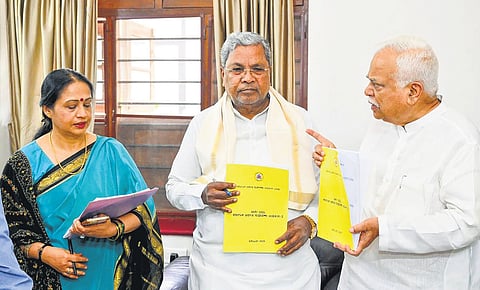
Former Minister and KARC-2 Chairman R V Deshpande submitted the 10th report of the commission to Chief Minister Siddaramaiah on Tuesday. The commission conducted a comprehensive review of sanctioned, filled, vacant and outsourced posts across departments, boards and corporations. Cadre and Recruitment Rules were examined to assess relevance to present-day functional requirements, said a note from the commission.
While recommending to the government to fill long-pending frontline vacancies on priority, particularly where vacancies have persisted beyond one year and affect citizen-facing services, the commission asked the government to freeze further outsourcing in Group-C and Group-D cadres where sanctioned regular posts exist but remain unfilled.
The commission recommended rationalising district-level staffing patterns by linking sanctioned strength to population, beneficiary load, regional backwardness and service intensity, converting redundant clerical posts into technical or multi-tasking posts, based on functional requirements and departmental inputs, and abolishing obsolete and functionally irrelevant posts identified through Cadre and Recruitment Rules review.
To strengthen governance systems, the commission recommended institutionalisation of a Reform Monitoring Unit (RMU) within the Department of Personnel and Administrative Reforms (DPAR-AR), integration of reform recommendations into departmental annual action plans and performance review mechanisms, and continued use of the online recommendation-tracking portal for transparent, real-time monitoring.
It also recommended closure, merger or consolidation of approximately 1,000 inactive heads of account/schemes that show zero or very small allocations or exist only for accounting/debt servicing purposes; joint review of 280 HOAs/schemes with allocations below Rs 1 crore, and formally merge or close schemes that are no longer operationally viable. It suggested phasing out legacy state schemes with negligible beneficiary coverage, recurring spillovers and the absence of measurable outcomes, and reallocating funds to high-impact schemes, the note stated.
The 10th report contains 355 new recommendations, bringing the total number of recommendations made in 10 reports to over 6,000, covering 42 departments.
