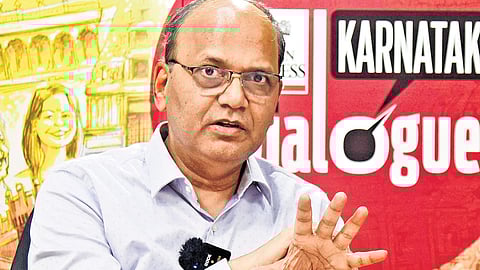

Former chief secretary and ex-chairman of the Second Karnataka Administrative Reforms Commission TM Vijay Bhaskar spoke to TNIE editors and reporters on the State and Union budgets, importance of having an elected local body in Bengaluru, cadre management and the recommendation made by the commission he had headed. Excerpts.
How are Central and State budgets changing over the years?
Budgets have changed after the introduction of GST, earlier there was scope to increase taxes, like sales tax. After GST, taxation matters are discussed in the GST Council. Now the state has control only on Excise, Stamps and Registration and Motor Vehicles taxes. At the state level, taxation has become less important. Budget is a policy document that lays a road map for the entire year. The chief minister is also the finance minister in Karnataka. Unless there is allocation for major schemes or projects in the budget, the government follows the same pattern with little changes. At the state level, there will be demand for new schemes to make the budget more interesting.
What is the process involved in budget preparation?
It starts with the Finance department, that estimates revenue generation for the year. The large amounts are for committed expenditure such as salaries, interests to be paid on loans, pensions, social security schemes, Central schemes and external aided projects. This leaves a small amount of uncommitted expenditure which is left to the discretion of the finance minister, who can announce new schemes or projects. The finance minister holds meetings with officials and ministers. Each department presents its expenditure for the year and also new schemes it wants to take up during the coming year. The CM and Finance department officials decide which ones are to be taken up, this is a political decision. Once this is finalised, the budget speech and budget estimation is also prepared.
What about Central budget allocation for the state?
Based on the Central budget, the State prepares a proposal. MNREGA, Samagra Shiksha Abhiyan and other schemes are committed expenditure, not much will change. There are three types of allocation, apart from externally aided projects, State-owned schemes which are completely funded by the State government, then we have Centre sponsored schemes, where part is funded by the State and part by the Centre, and the third is Central sector schemes which are completely funded by the Centre. Nowadays, major expenditure is for land acquisition which is on the State government.
Does Karnataka have enough funds for all developmental activities?
Karnataka has sufficient funds for developmental activities. Guarantee schemes generate revenue as spending leads to increased tax collection. When large sums, like Rs 50,000 crore, are spent, a significant portion returns to the state through taxes due to the multiplier effect. Karnataka has the second-highest per capita income after Haryana and Telangana, making it financially capable of such schemes. As the economy grows, revenues will rise. Additionally, new financing sources, such as asset monetization, are being explored, reducing dependency on taxes. The government possesses significant assets that can be leveraged for funding.
What are the challenges Bengaluru is facing without an elected BBMP Council?
Without an elected body, addressing local issues becomes difficult. Citizens need a direct point of contact for their grievances, and elected representatives play a crucial role in resolving small conflicts efficiently. While MLAs are present, they operate at a higher level and are often overwhelmed by the large population they serve. As a result, it may be challenging for local citizens to approach them for immediate concerns. Elected councillors, on the other hand, act as accessible representatives at the ward level, ensuring that local issues are addressed promptly. Their presence is essential for effective governance and grievance redressal.
The elections have been delayed due to legal matters like court cases....
It is ultimately a political decision. The Constitution mandates that elections should be held within six months. As the case is before court, we must wait for the court’s decision.
After the Union Budget, there has been a feeling in Karnataka, especially among those from the ruling Congress, that the state got “chombu”. What is your opinion?
The allocation to states is determined by the Finance Commission. The key factor here is the transition from the 14th to the 15th Finance Commission, during which Karnataka’s share was reduced from approximately 4.7 per cent to 3.6 per cent. The primary reason for this reduction is the increase in our per capita income. The Finance Commission gives the highest weightage to the distance of a state’s per capita income from the national average. Since Karnataka’s per capita income has risen, our allocation has decreased accordingly.
Between the 14th and 15th Finance Commission, new income from software and services earnings, which was not being counted earlier, started getting counted and per capita income increased. As the formula of allocation remained the same, the state got a lower allocation. We can say that our economic success has been the main reason for low allocation in the 15th Finance Commission share.
The census is another reason for low allocation as we still depend on the 2011 census, post which a lot of migration has happened into the State, which is not being counted. Once the next census happens, our population will also go up and give us a higher share of total allocation. One legitimate grievance of the State is the 15th Finance Commission’s interim recommendation of a special grant of Rs 5,495 crore and some state-specific grants have not been released.
What should be done to prevent tax evasion?
The three biggest sources of income for the state are Excise, Transport and Commercial Taxes. There is a lot of tax evasion happening. If one wants to build a house and purchases items like tiles for construction, in many cases only if the bill is demanded, the shopkeeper gives one.
While registering properties, both sellers and buyers prefer to get part of the money in ‘black’ because guidance values are much lower than market rates. To curtail tax evasion, each department is given targets in terms of revenue generation.
What is your opinion on the microfinance issue?
Microfinance was started as a means to empower people, especially women, through Self-Help Groups and help them get credit at cheaper rates, and was seen as a poverty alleviation programme. It later turned commercial. While banks lend at 10 per cent interest, microfinance firms charge over 19 per cent, which is almost 10 per cent higher.
There were two types of microfinance institutions (MFIs): those registered with RBI that follow guidelines, and the unregistered ones which do not follow any rules or procedure, and are the major cause of all the recent issues that have cropped up with microfinance. The ordinance the government is planning will help regulate unregistered and unregulated microfinance institutions.
A large number of MFIs are registered and being regulated by RBI. Seeing their success, unregistered companies have been coming in over the past five years to make some quick money. All this did not gain much traction but now because of all the suicides, it has got more attention.
Why are so many people in rural areas taking loans at such high interest rates?
Regulated MFIs are doing good work. Unlike banks where loan processing duration is more, MFIs check a customer’s credit score from the Aadhaar number and source of income, and sanction loans. In some cases, they sanction loans within hours. People take these loans for immediate business purposes. Once they get into the habit they take more loans, and have two or three loans from registered companies. When those avenues are closed, they go for unregistered companies. Easy availability of finance is one reason for this.
What kind of awareness must people have when they take loans from microfinance?
People must know what their repaying capacity is, and how much burden they can take. Nowadays there are many cases of online credit, online gaming, online gambling, where people lose a lot of money and commit suicide. Covid also had a role to play. Youngsters with nothing to do for one year, got into habits of online gaming, online betting and online gambling. The state government brought a bill to control online gambling. The issue is pending in court as gaming companies have challenged it.
Which is the posting you enjoyed the most?
I was in the Education department as Commissioner of School Education and Principal Secretary of School Education which I liked the most, and gave me immense job satisfaction. Education was the reason I could come up in life.
Why is cadre management becoming an issue? What is the solution?
Earlier, the intake of IAS officers was 140. In my batch, we were about 140-odd officers. This was later reduced in the early 1990s to 80. While in my batch in 1983, we had six officers in Karnataka, in the 1992 batch, there was just one officer in Karnataka cadre. This situation was there for about five years. After that the government realised this was not working and reverted to the old number. This is the problem in all the states. In IAS, one-third percentage is for officers who are promoted from the state service.
Is interest in civil services declining among younger generations?
No, interest is not declining, the pool of applicants has increased, but the private sector offers more opportunities and higher salaries so more avenues are available.
How do you view the changes since you joined as a probationer and became chief secretary? What differences did you see in political involvement and engagement over time?
Since Independence, the power balance has shifted from a strong bureaucracy to elected representatives. Initially, bureaucrats, with their ICS background, had more influence, but after the 73rd and 74th Amendments, and with more educated and financially capable elected leaders, power has increasingly moved towards them. This change has allowed elected representatives to better understand policy issues and provide stronger political and policy leadership.
Did you face any pushback or interference, or have confrontations during your tenure? Was it a common part of your official role?
In government service, differences can arise between officers and elected representatives. It depends on how they resolve these issues, keeping the people’s interests as the priority.
Can you explain how the Administrative Reforms Commission’s recommendations were implemented?
When I first joined the Administrative Reforms Commission, people believed the commission’s recommendations would be ignored, but we made recommendations that are practical and feasible, based on feedback from officials. These process-oriented reforms, like improving service delivery or websites, were harder to oppose. Out of 5,039 recommendations, nearly 2,500 have been implemented or are under implementation, with continuous reviews to ensure progress, particularly in integrating technology for faster services.
Has technology helped to reduce corruption?
Yes. For example, under the Gruha Lakshmi scheme, nearly one crore women got Rs 2000 directly into their bank accounts within a month or so, because of the Direct to Bank Transfer (DBT) scheme, without any middleman being involved. This is thanks to Aadhaar which is linked to bank accounts. Also based on Aadhaar, we have the Kutumba database, where we know who is below the poverty line. With ration cards, we have details of family members and their status. With the help of Vaahan, we know how many have cars and other vehicles. Through these, we know how many are BPL and to what caste they belong. This helps the government roll out schemes without any leakages or corruption. No one has to apply.
What special measures need to be taken to improve the education sector?
In our report, we said multigrade education is a big problem in Karnataka. The state should aim at single grade education as it is the most basic thing, by opening more Karnataka public schools.
Urban housing is a serious concern. How to address it?
Housing is one issue of concern, apart from inflation. The government can address housing issues by easing up planning restrictions. Densification is something the city needs. There is a need to be more practical and make housing more affordable.