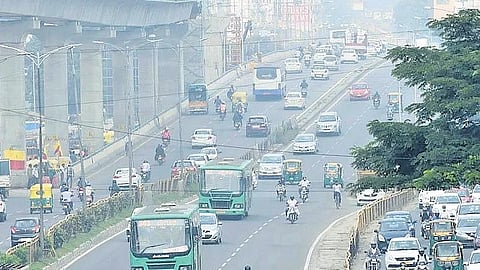

MANGALURU: Bengaluru, Davanagere, and Hubballi-Dharwad have made modest strides in improving air quality under the Union Government’s ambitious National Clean Air Programme (NCAP), according to the Ministry of Environment, Forest and Climate Change (MoEF&CC). This was revealed as a response by the ministry in the ongoing Lok Sabha session.
While Karnataka received significant funding and saw measurable improvements in several cities, challenges in full implementation and fund utilisation remain.
Launched in 2019, NCAP aims to reduce air pollution levels across 130 non-attainment and million-plus cities through city-specific Clean Air Action Plans (CAPs). Karnataka has been actively participating, with the Centre sanctioning Rs 597.52 crore from FY 2019-20 to FY 2024-25 and allocating Rs 194.41 crore for 2025-26. However, only Rs 14.2 crore has been released so far this year, raising concerns over the slow pace of fund disbursement and on-ground implementation of the programme.
According to the ministry, Bengaluru, Davanagere and Hubballi-Dharwad have reported a 20-40% reduction in PM10 levels in FY 2024-25 compared to the base year 2017-18. Also, Davanagere and Kalaburagi have met the National Ambient Air Quality Standards (NAAQS), with PM10 concentrations below 60 gm.
However, not all cities in Karnataka are faring equally well. Kalaburagi, though meeting NAAQS now, is the only Karnataka city listed in the 20% improvement category, showing that more sustained efforts are needed. The absence of cities achieving over 40% improvement further emphasises the gap between targets and outcomes.
The ministry highlighted that recent policy revisions mandate the use of funds in five key intervention areas, including mechanical road sweeping, greening of traffic corridors, dust control on roads, and traffic decongestion. Karnataka’s Urban Local Bodies (ULBs), in collaboration with the state government and the MoEF&CC, have signed MoUs to ensure accountability and convergence with other government schemes like AMRUT and Swachh Bharat Mission.
Nationally, 103 of 130 cities under NCAP reported a reduction in PM10 levels, with 25 cities achieving more than 40% reduction. A total of Rs 13,036.52 crore has been released as performance-linked grants to support these initiatives across India.
