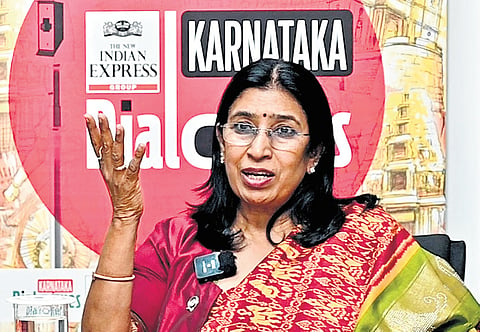

Elected as the first woman president of the century-old Federation of Karnataka Chambers of Commerce and Industries (FKCCI), Uma Reddy says for Karnataka to be on top in terms of MSMEs, i t needs to adopt technology and have a good ecosystem.
Uma, who climbed the ladder to the top position, speaks on multiple issues -- poor infrastructure, challenges faced by industry, friction between industrialists and government, GST 2.0, looking beyond Bengaluru, geopolitical uncertainty and impact of climate change in an interaction with The New Indian Express.
Excerpts:
How does it feel to be the first female chairperson of the century-old FKCCI?
It’s both overwhelming and humbling. Humbling, because it was founded by none other than Sir M Visvesvaraya. To think that somebody had that vision 108 years ago, and for the organisation to be relevant after all these years, is extraordinary. It clearly shows he was a true visionary to think there was a need for a chamber of commerce.
Overwhelming, because you don’t realise the significance; I’ve been in the chamber for 20 years. Having sat there, you don’t really feel somebody different, but I’ve realised there are a lot of eyes on me. That’s been women’s forte in the country for decades, and there is always the “what would a woman do” question. So we are constantly, as women, trying to prove ourselves and show we can do it.
What do you see as the short and long-term challenges for business in Karnataka and the industry itself ?
When you’re part of a chamber of commerce, you’re part of a mainstream organisation. You are no longer in women-owned or women-run organisations. Once you are there, gender doesn’t matter: the business or product has to speak for itself. When it comes to organisations like chambers of commerce, the challenges are not necessarily for women-owned enterprises. We have nearly 5,000 direct members across all sectors, and another 2 lakh members (from 140 associations). Every district of Karnataka, more or less, has a chamber of commerce. Each of these chambers has hundreds of members, and each member’s challenge is very different.
Can you give a couple of examples regarding the challenges faced?
Tourism can be seen as good for any region’s industry, but a place like Kodagu does not have the infrastructure to sustain it. The roads are inadequate, and it’s difficult to prepare for waste management that comes with tourism. A representative from Kalaburagi brought up another problem: a Bengaluru-Kalaburagi flight under the UDAN scheme has been cancelled, affecting logistics. So as a chamber, we are always collecting information on challenges. We met Union Minister of State for Railways V Somanna to propose a train corridor for freight movement, especially for coastal areas like Mangaluru. So these are constant efforts, and we hope someday they all see the light of day.
Which regions in Karnataka, beyond Bengaluru, have the potential to attract high investments?
Mysuru is the closest, but places like that and Tumakuru are now seen as close enough to be analogous to Bengaluru. A place like Mangaluru has a huge student community, and a port is also coming up there. Hubballi and Belagavi have a lot of potential as well. Tourism thrives in these places, and they attract investments. The aviation industry in Kolar is notable as well. Things will improve when connectivity to places like Kalaburagi improves.
What is the status of the minimum labour wage revision?
The Labour minister had proposed a steep hike in minimum wages a year-and-a-half ago. Since industries were not consulted before the announcement, employers challenged the move. After discussions, the proposed figures were lowered to around Rs 26,000 and Rs 21,000, but no final order has been issued. Industry bodies stress the need to stay competitive with Tamil Nadu and Andhra Pradesh, where wages are much lower. With 96 per cent of Karnataka’s industries being micro and small units, uniform wage across all enterprise sizes is impractical. A differentiated structure or proper stakeholder consultation is essential.
How has GST 2.0 impacted industries?
GST 2.0 has been largely positive for the garment sector and aquaculture due to tariff changes. Despite India losing some garment production to Bangladesh and Sri Lanka, Karnataka did not see major disruptions. Some sectors, such as the paper industry, have been hit by tariff increase from 12 per cent to 18 per cent, raising textbook and notebook costs. These issues have been taken to the GST Council. Reduction to two GST slabs is seen as a good move, though many believe the higher slab could have been lower.
What complaints do industries commonly raise with the government?
Key issues include infrastructure problems and difficulties with the e-Khata system — technical glitches, document upload failures, and delays. Industries are also facing steep property tax hikes and unclear building regulations. Another concern is the Pollution Control Board’s fee structure, which is based on land or building size rather than actual pollution levels. These matters are taken up by the chamber through policy advocacy.
How does geopolitical uncertainty in trade affect industries in Karnataka?
Geopolitical uncertainty creates risk aversion. When the global situation is unpredictable, entrepreneurs hesitate to invest or expand, and many delay major decisions. This kind of uncertainty is not healthy for industry, and it has been particularly strong in the last few months. The impact is global — every country is dealing with constant shifts in trade relationships. For instance, we once spoke about ‘China plus one’ and projected India as the natural alternative, but now India is moving towards an FTA with China. The situation keeps changing like a ping-pong ball, making long-term planning difficult for industries.
There seems to be friction between industry leaders and the government, like recent statements by Kiran Mazumdar-Shaw or Mohandas Pai. How do you view this?
It was good that industry leaders spoke up, even if the government initially objected to their statements. Ultimately, both sides seem to have reached an understanding. Raising concerns is important because it highlights what Karnataka stands to lose if issues aren’t addressed. Some companies have already shifted to Tamil Nadu or Andhra Pradesh, though they could easily have been in Karnataka. The fact that the Chief Minister called a high-level steering meeting shows the government recognises the seriousness of the situation.
Infrastructure remains a major issue. For example, in Peenya Industrial Area, the roads are in terrible condition — large vehicles can barely pass. Continuous rains since July have made it worse, with little opportunity for repair work. All this affects industrial confidence and daily operations. When we build infrastructure, we need to be world-class. India has a long way to go because China’s industrial parks are world-class. We are spending on trade costs, which is an additional cost, and building into the product cost. Without infrastructure, how can one compete globally in terms of industries.
What is your appeal to industries — should they explore opportunities in Karnataka or states like Andhra Pradesh and Tamil Nadu?
Whatever the issue, we are Indians in true spirit. As a traditional practice, we will promote and do a balancing act of talking to the government to ensure industries remain in Karnataka. I think one company leaving the state will not be a trendsetter. Our objective is to get everybody to stay here.
During your interactions with companies, have they told you they are unhappy with infrastructure in the city?
A private Japanese company in the business of assembling components could have set up a manufacturing unit in Karnataka; however, they set up a factory in Chennai. They have huge projections of growth in the engineering industry. I was told that Tamil Nadu Chief Minister MK Stalin personally facilitated it.
Are industries not looking beyond Bengaluru? Is it because other regions lack infra?
Land might be available in Ballari to set up industries, but where is the infrastructure? How will people travel without proper flights? Industrialists would be happy if there is good flight connectivity so they could invite investors and visitors from other countries, so people choose to stay in Bengaluru.
How has climate change impacted growth of industries?
As a chamber of commerce, we have run a campaign on CSR and sustainability to tackle climate change for a few years now. All multinational companies, SMEs, small enterprises and other industries have to follow standard environmental, social and governance norms. It is very important that everyone reduces their carbon footprint. A mechanism can be set up to create competition among industries so they keep a tab on carbon footprint and reduce it. FKCCI is working on such tools.
Do you see the difference in the journey of women entrepreneurs, compared to your time?
I started my entrepreneurship journey in 1984 when the analog economy existed. Digital clocks were being developed in 1984. Moving from analog to a digital economy, we have now surpassed with AI and machine learning to quantum. We have grown through all these transitions, and in terms of workforce but have few women entrepreneurs. In the 1980s and 1990s, there were only 10 to 12 women-owned enterprises and I don’t think we have gone beyond 15 per cent. There are a few women-owned enterprises in medium and small-scale industries. We have a large number of women in the self-employment sector. If you go to other districts, you see women selling different products on streets, employing two or more people. However, we don’t term them an enterprise, they are part of the informal market structure.
What is the scenario of MSMEs in Karnataka?
We have about 7 lakh MSMEs registered in Karnataka. They continue to have internal and external issues. On the other side, MSMEs continue to grow, and that is what matters. If Karnataka has to be on top in terms of MSMEs, they need to adopt technology and ensure we have a good ecosystem.
Can you tell us about FKCCI’s programme providing hands-on skills to students to become entrepreneurs?
FKCCI is currently having the 19th edition of Manthan, a business plan presentation programme for college students. We get over 600 applications for this programme. At the end of the final round, we give Rs 10 lakh cash prize to 10-12 students. They present their business ideas, which are later handheld by professionals. They go through a first knowledge workshop where they are taught about preparing a business plan, execution and much more. By the time they attend the third knowledge workshop, they understand the nuances of maintaining a balance sheet to providing service or products. At the start, there are 2,000 students but in the final round, around 50 students get the cash prize. The Higher Education minister has pushed for enrolling government college students too.
We are on the edge of Industry 5.0, while the gig economy is also growing. Many people work in low-skill jobs. Do you think India lacks skilled labour, especially in IT or other industries?
India has a rich dividend of the young, driving various industries, yet many SMEs struggle to find skilled workers like turners, fitters or CNC operators. Despite abundant graduates, many remain unemployable due to a lack of industry-relevant skills. The government’s push for internships promotes practical learning where students gain hands-on experience before higher studies. These internships, now integrated into academic semesters, help bridge the skill gap.
There are concerns about US pressuring India to buy soybean and corn for ethanol, and high tariffs on ships from Andhra. What is the industry’s reaction?
Andhra was badly affected by high tariffs, especially in aquaculture, while Karnataka remained relatively shielded due to government measures and industry structure. Andhra’s sector, however, faced significant challenges during that period. When tariffs were imposed, FICCI held meetings across state chambers, including Bengaluru. Each state shared inputs, which FICCI Delhi collated and submitted to the PMO and commerce minister regularly.
Do you see more new startups emerging in areas like supply chain and microchips after Covid-19 exposed weaknesses there?
The chip shortage during Covid-19 severely impacted industries, especially automobiles, as most chips came from China and the US. Chip manufacturing requires large-scale investment, not feasible for small industries. The government has recognised this and recently announced major support for the Electronic System Design and Manufacturing (ESDM) sector. India has made progress in electronics, moving from fully importing components to developing some domestically, but dependency on imports remains high.
What is the impact of Artificial Intelligence (AI) on industry?
At FKCCI, we focus on skill development programmes in AI across sectors, especially for SMEs. Many small businesses see AI as only for tech firms, but we promote it as a practical tool to improve productivity, efficiency and quality. We’re developing training modules to help industries adopt AI effectively.
What is your opinion on the government proposing one-day menstrual leave?
As a woman, I appreciate the idea of having a day off when needed — it’s empowering and supportive. However, the real issue is who bears the cost of that extra leave. For small enterprises, unexpected absences can disrupt operations and discourage hiring women. Such policies need practical consideration and consultation to avoid unintended consequences. Flexibility should depend on the nature of work.
During Covid-19, many industries cut costs and jobs. Should the Central government create a policy to provide financial support to industries during such future crises?
The government has more pressing priorities than preparing for another possible Covid-like event.
During Covid, industries mainly benefited from temporary PF relaxations and deferred loan payments. SMEs received limited relief; some recovered, others didn’t. Currently, the focus should be on strengthening infrastructure, building a stable ecosystem, and supporting long-term industrial growth. Short-term subsidies cannot sustain industries — what’s needed is a strong, supportive business environment that helps companies grow and stay resilient, regardless of future crises or disruptions.
