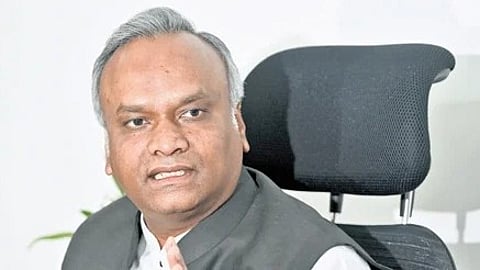

BENGALURU: The Karnataka government is likely to introduce the Karnataka Misinformation and Fake News (Prohibition) Bill, 2025 in the next Assembly session, IT/BT Minister Priyank Kharge said on Friday, asserting that the proposed law targets only “harmful falsehoods presented as fact,” and not dissent, humour, or creativity.
Speaking at Truth, Trust & Technology: A Policy Dialogue on Online Speech Regulation, Kharge said the bill is being drafted in consultation with the Law and Home Departments. “We are not criminalising humour, dissent, or creativity. The bill excludes satire, parody, opinion, and art. We are only criminalising the spread of harmful falsehoods presented as fact,” he said.
The minister described misinformation as a threat to democracy, society, and the economy. “The World Economic Forum’s 2024 Global Risks Report ranks misinformation and disinformation as the number one short-term global threat. Disinformation is not harmless — it is weaponised deception,” Kharge said.
He added that public consultation would be central to the bill’s process. “We have started a very important dialogue today. This should not remain within four walls — it must be debated publicly so that people understand the dangers of misinformation, disinformation, malinformation, and fake news.”
Kharge said the aim of the legislation is to build a society rooted in scientific temperament and economic growth.
A panel discussion on Regulating Speech in Karnataka: A Constitutional Tug of War followed Kharge’s keynote.
Sudhir Krishnaswamy, Vice-Chancellor of NLSIU, said the state has legislative competence to enact such a law. “The question is not competence — it is prudence,” he added. He warned that platforms must share liability and pointed to global precedents.
He further added, “We need to separate the issue of hate speech from misinformation. Conceptually and in practice, they function differently. They should not be clubbed together, and we must be careful in keeping them apart.”
However, Manu Kulkarni, Partner at Poovayya & Co., cautioned against the state becoming the arbiter of truth. “We already have legal pathways to tackle misinformation. Creating new laws won’t help if offenders are never prosecuted.”
Alok Prasanna, Co-founder of the Vidhi Centre for Legal Policy, argued that criminal law is the “easy but wrong solution.” He said, “The core problem is that we don’t teach critical thinking. When you don’t allow a marketplace of ideas to flourish, misinformation is the natural consequence.”