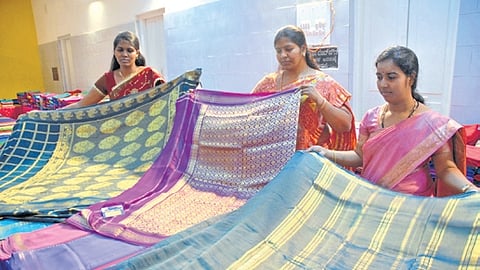

BENGALURU: Karnataka, India’s largest silk producer, will have another feather in its cap. The country’s first silk museum will be established in Mysuru, which is famous for its silk sarees. The museum will showcase the entire history of silk in India, as well as the entire cocoon-to-garment process.
The Central government has already started silk tourism in Jammu and Kashmir and is also working on establishing another circuit in Topatali in Assam. While the state government and Centre are popularising the silk chain and fabric in these two states, in Mysuru, a museum showcasing how silk thread is procured – from the pupa stage to how its woven into a fabric will be shown, said Central Silk Board’s (CSB) National Silkworm Seed Organisation (NSSO) Director Dr Manthira Moorthy.
“This will be the first-ever and unique museum. A dedicated team is being deployed to work on this. The total cost of the project will be known after tenders are finalised. The museum will be set up in CSB’s centre in Mysuru, which is spread across 120 acres,” he said.
For creating the museum, CSB officials have studied similar centres in China and Italy. They have also studied the best of collections in Italy and 2000-year-old collections in China. Work has begun to gather traditional and heritage collections from all silk-producing states and farmers to showcase in the museum.
Museum display highlights how to identify real silk
“We aim to start work on the ground from the coming financial year and complete it in two years. Here old collections will be showcased. Details of the importance of the silk mark and how to identify original and fake silk will also be explained.
Experts and farmers are being roped in for the project. The project is promoted by the Ministry of Tourism,” said CSB member Sivakumar Periyasamy.
The museum will also feature a dedicated section showcasing silk byproducts. There is a rise in the global market for silk protein and other products used in the cosmetics and pharmacy. This trend will also be demonstrated to people visiting the museum, he said. According to the Seri-States of India 2024, Karnataka contributes around 32% of the country’s silk production. There are 11,526 sericulture villages, housing 1,48,704 sericulture farmers and 6,749 reelers.
Sericulture was introduced in the region and encouraged during Tipu Sultan’s era. The primary cocoon production regions include Chikkballapura, Kolar, Ramanagara, Mandya, Mysuru, Chamarajanagar and Bengaluru Rural. Later it is expanded to multiple places. The report also stated that Karnataka produced 12,463 tonnes of silk in 2023–24, which included 2,806 tonnes of Bivoltine silk and 9,657 tonnes of crossbreed silk.
