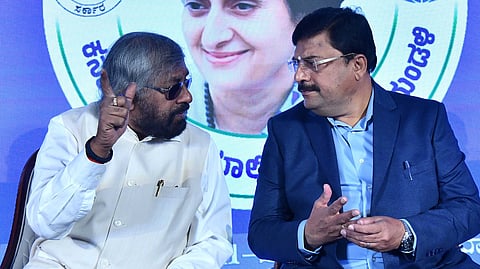

BENGALURU: To mark 50 years of Karnataka State Pollution Control Board (KSPCB) a conference on circular economy and sustainability was organised in Bengaluru on Tuesday.
Speaking on the occasion, Karnataka Forest, Ecology and Environment Minister Eshwar B Khandre stressed that due to the failure of the old economic model — ‘take, make, use and discard’— the circular economy is no longer an option but a necessity.
Khandre stressed that India can no longer treat nature as an “unlimited warehouse.” He argued that rethinking how society produces, consumes, reuses and regenerates resources can strengthen economic resilience, reduce demand on vulnerable supply chains, and boost green innovation.
KSPCB Chairman PM Narendraswamy said the KSPCB’s mandate has evolved significantly. “As the environmental regulator, our role extends far beyond enforcement.
We are ready to act as facilitators of change — promoting cleaner production, supporting circular business models, and building synergies across government, industry and academia.” He highlighted that sustainability demands a shift in mindset — from consumption to conservation and from compliance to commitment.
A panel discussion on environmental regulation compliance by local bodies was organised. Speaking on wastewater management, panelist Nalinakshi representing Karnataka Water Supply and Drainage Board (KUWS&DB) highlighted persistent gaps. “Local bodies readily support water-supply projects but are reluctant on underground drainage.
Residents oppose pipelines and hesitate to provide land for STPs, delaying projects,” she said. She added that 38 KUWS&DB-maintained STPs meet KSPCB and NGT norms, and 17 have received Jal Jeevan Mission incentives. However, lack of sewage tax collection in many Urban Local Bodies affects maintenance, and public acceptance of recycled water remains low.
Greater Bengaluru Authority Chief Commissioner M Maheshwar Rao identified air quality, water contamination and solid-waste management as Bengaluru’s most urgent concerns. He said dust pollution—especially from debris dumping—will dominate discussions in the coming months. Under the ENCAP programme, Bengaluru plans to expand mechanical sweeping and set up debris-processing units where private firms can convert construction waste into M-sand.
On solid waste, Bhanumati from the Department Administration Municipal said Karnataka’s 316 ULBs generate about 13,000 tonnes of waste daily, of which 10,000 tonnes are processed. About 78 lakh MT of legacy waste has been cleared so far under Swachh Bharat Mission, she said, adding that 315 ULBs now have material recovery facilities.
The conference concluded that circular-economy solutions — supported by coordinated governance — remain critical to strengthening Karnataka’s environmental resilience over the next decades.
