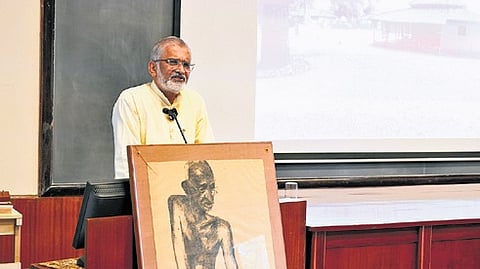

BENGALURU: “We should not absolve the government of its regulatory role with regard to health. At the same time, it is imperative that one is also responsible for their own health,” said Padma Shri Dr Abhay Bang, co-founder at the Society for Education, Action and Research in Community Health (Search), at the 51st Gandhi Memorial Lecture at Raman Research Institute (RRI). Dr Bang’s lecture was titled ‘Research with the People: Experiments of Healthcare inspired by Mahatma Gandhi’.
The Gandhi Memorial Lecture series was started by none other than CV Raman himself. Dr Bang started his lecture by calling himself a pendulum hovering between the ideals of Gandhi and Raman, and drew from his experience in serving the impoverished communities of Gadchiroli, a district in Maharashtra. This experience added up to his establishment of ‘Arogya Swaraj’, the concept of health as autonomous and self-governed. “This is my life’s work,” he said, “to create villages that can govern their own health.”
One of the most important facets of Dr Bang’s work was to revolutionise neonatal care in the villages of Gadchiroli when infant and natal mortality rates were a pressing concern, the nearest medical facility being 200km away in Nagpur. “If mothers and infants cannot travel to a hospital, the hospital must come to them,” he said.
This principle led him to establish home-care agents, or ‘Arogyadoots’ -- 39 women trained to deliver babies with proper medical decorum. One of them was Kaju Bai, a Dalit woman who has now been an Arogyadoot for around 20 years. “This is not just about saving children, it is also about empowering women. All their lives, otherwise, they would be daughters, wives and mothers; with this, they are entities,” he said.
Dr Bang concluded his lecture touching upon how the researcher should “go where the problem is, not where they are the problem”. He stressed that the path to achieving health resides within ourselves. “The Gandhian path of healthcare would be Arogya Swaraj,” he said.
