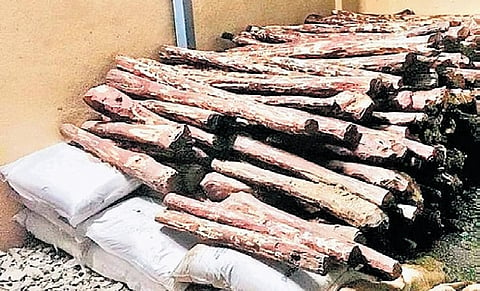

BENGALURU: The quality of farm-grown sandalwood in Karnataka is on the decline, and so is the quantity of extracted wood. In such a scenario, Australia, that had once imported seeds from Karnataka, is now exporting sandal oil to the state to meet demand.
Further, with the shortage of raw material, private companies and Karnataka Soaps and Detergents Limited (KSDL) are diversifying their business to non-sandal based items like jasmine, rose, lavender and aloe vera.
“From 100kg of wood, 4-5kg oil is extracted. In the 1980s and 90s, two tonnes of oil was extracted at each of the two distilleries in Shivamogga and Mysuru. Now, their collective annual extraction is also not as much. There is a 60-70 per cent shortage of wood and oils. We are importing 5000kg of oil from Australia and this is increasing year-on-year,” said a KSDL official, seeking anonymity.
“Australia has become one of the largest suppliers of oil. Since Karnataka’s sandalwood is of supreme quality, Australia took the seeds from Karnataka in the 1990s and harvested them in a secure environment. Good quality of oil was extracted and Australia is gradually becoming a leading exporter of sandalwood oil. Apart from getting farm-grown wood, we are procuring wood from Tamil Nadu, Kerala, Gujarat and Madhya Pradesh to meet demand,” the official added.
The decline in quantity and quality was highlighted in the report of the Sandalwood Development Committee, released on Wednesday by the Central Vista Oversight Committee. The report also pointed to Australia as the largest sandalwood market with about 69 per cent market share, and India follows with 20 per cent market share.
The report stated that the future value of sandalwood plantations from Australia ranges from Australian $20,000-41,000 per tonne for Indian sandalwood, and Australian $3,000-16,500 per tonne for Australian sandalwood.
Officials at the Institute of Wood Science and Technology explained that though sandalwood is a hardy species and needs a stressful environment to grow, reduction in soil quality, land fertility, and improper protection environment is leading to poor quality. Principal Chief Conservator of Forests Meenakshi Negi said the quality of forest wood is the same, but that of farmlands has reduced.
The quantity of forest supply has also reduced, and efforts are on to increase it on farmlands.
The Karnataka Forest (Amendment) Bill, 2001, allows cultivation of sandalwood on private lands. This policy change has encouraged private individuals to cultivate and protect the tree. The policy also authorised KSDL and Karnataka State Handicrafts Development Corporation (KSHDC) to buy sandalwood directly from land owners though applications still have to be filed and routed through the forest department.
“The report projects that by 2040, sandalwood production in India will rise. It can be paced up with aggressive plantation as part of afforestation efforts. If the tree is meshed and guarded, it is identified. But if left alone and allowed to grow for 15-20 years, it is no problem. Micro-chipping the trunk to monitor growth and protection should be done,” a forest official added.
KSDL Managing Director Prashanth PK said to increase wood procurement, they have signed MoUs with 735 farmers and sandalwood is now growing on over 4,000 acres. But a lot more needs to be done as demand is rising. Due to shortage, KSDL is diversifying into other items, he said.
