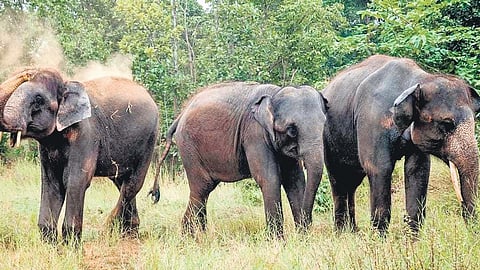

BENGALURU: Release of DNA-based elephant population estimation is the beginning for the scientific and wildlife fraternity. According to experts from Wildlife Institute of India (WII), who prepared the report, a detailed gene pool assessment is being done as the next step, with special concentration on Western Ghats and the Nilgiri Biosphere.
According to Status of Elephants in India: DNA Based Synchronous All India Population Estimation of Elephants, Karnataka houses the highest elephant population of 6,013 in India, and the Western Ghats region (Karnataka, Kerala and Tamil Nadu) has 11,934, which is nearly half of India’s elephant population.
The teams assessed 21,056 dung samples for the exercise from 2021-25, and concluded the presence of 26,645 individuals in India. The report said, “The once-contiguous elephant population in the Western Ghats is rapidly disconnecting due to changing land use, including expanding commercial plantations (coffee and tea), invasive plants, farmland fencing, human encroachment and mushrooming developmental projects. This fragmentation jeopardizes habitat contiguity, emphasising the importance of safeguarding connectivity to enable movement between populations.”
Currently, elephants are distributed in pockets amid human habitation, plantations and mines. It is crucial to ensure corridor connectivity across habitat patches and better strategies for law enforcement monitoring, for long-term survival of this species. Electrocution and railway collisions cause a number of elephant fatalities. It is essential to engage with community for sensitisation campaigns, researchers pointed out.
They said the Western Ghats and Nilgiri Biosphere offer a promising elephant population. DNA assessment and data collected will also help solve elephant wildlife crimes, which has proved successful with tigers and elephants.
A researcher from WII told TNIE that unlike tigers, camera trap images were of limited use for elephants. Samples were taken from all forested areas, but not coffee estates.
Manoj Rajan, Additional Principal Chief Conservator of Forests, Project Elephant, said that as per DNA-based assessment, in the 2017 national synchronised estimation, Karnataka had 6,049 elephants. The difference is a marginal decline of only 36 elephants (1%) which is well within the expected statistical range.
“Karnataka’s stable figures reinforce that the state’s management systems remain effective. Our focus now shifts from numbers to quality of habitats, genetic health and safe connectivity,” he said, adding that the key conservation thrusts will include securing elephant corridors and habitat linkages to sustain free movement and genetic flow; conflict reduction through science-based land use planning, real-time tracking; conservation models, incentivising coexistence and transboundary coordination with Tamil Nadu and Kerala for joint operations in the Nilgiri Biosphere and contiguous habitats.
