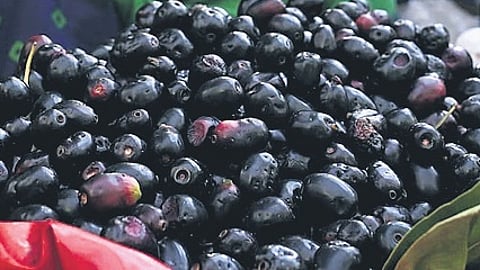

BENGALURU: While consumers know the names of most of the varieties of mangoes they consume, there are many other vegetables and fruits that are consumed on a daily basis, but people do not know their names. One of the fruits in the list is jamuns- also known as Black plum or lava plum.
The Indian Council for Agricultural Research (ICAR)- Indian Institute of Horticultural Research (IIHR) have successfully developed new varieties of jamuns which will soon be registered and patented. This is apart from the three new jamun varieties that a Bengaluru-based progressive farmer, NC Patel, has grown in his land, which is also going to be registered and then be available in the market.
Dr G Karunakaran, principal scientist, ICAR-IIHR, said, of the two new varieties that have been developed, one is Jamun Nerantara, which is found near Pavagada. The variety is found in a land belonging to one farmer, and he is protecting the species under the Protection of Plant Varieties and Farmers’ Rights Authority (PPVFRA). This is because there is only one tree that is producing this variety, which is unique because of its sweetness, chewy texture and seed.
The other variety is yet to be named. This one has been developed in the institute and is presently called IIHR-JI. Its uniqueness is the size, each measuring 23-24 grams and each tree bears around 100 Kg of fruits. This is so far the largest variety and is less astringent, said Karnunakaran.
As per ICAR-IIHR, Karnataka already has multiple varieties of jamuns, including the Dupdal variety from north Karnataka, Siddamani jamun (also known as Chintamani jamun) and two varieties from Bagalkot.
Karunakaran added that, unlike other fruits, the variety of the jamuns changes region-wise and it depends upon the soil, environmental influence, climatic conditions, gene pool and method of cultivation. Work on patenting and registering the new varieties is being done, and trials on an Indian basis have already started.
He added that a large number of jamun fruits that consumers consume in the market also come from Andhra Pradesh, Tamil Nadu and Kerala.
Explaining his new produce, Patel said, he started cultivating three new varieties--Patel Jumbo, Patel Samrudhi and Patel Akal-- from 2005, and now around 150-200 plants of each variety are being grown.