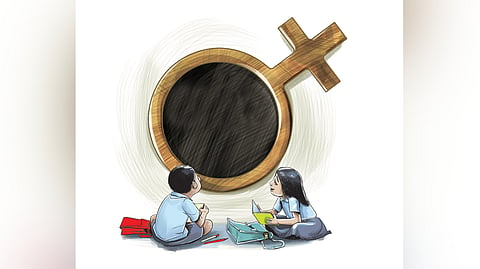

BENGALURU: While Karnataka is known for premier institutions and a tech thriving economy, for every 10 men who can read, nearly two women still cannot. The latest Periodic Labour Force Survey (2023–24) shows 88.1% literacy among men, compared to just 77.3% among women, a gap of 10.8 percentage points. As per the figures, consolidated by the Karnataka Child Rights Observatory and vetted by UNICEF for the two-day workshop conducted for School Health and Wellness Programme, overall literacy rate stands at 82.7% for the state.
Neighbouring states like Tamil Nadu and Kerala have managed to bridge this divide, in terms of both gender and literacy, through large-scale re-enrolment initiatives and state-wide literacy missions. Karnataka introduced programmes like dor-to-dor survey to understand the dropout rates, but these programmes remained scattered and have not reached every district with equal intensity.
The distance to schools, particularly secondary schools, the drop in school numbers, specifically after primary level, and the shortage of teachers including instances where a single teacher handles the school or students from multiple grades are compelled to sit together, have all added to the problem, resulting in dropouts that have further widened the gender gaps. In regions like Yadgir and Raichur, where both literacy and intervention to improve it remained low, these barriers leave students, mostly girls, at risk of slipping out of the system.
Karnataka in 2016 gave a commitment to the Union government that it will have no dropouts over the next three years. But the state recorded 18,461 dropouts in the 2022–23 academic year, one of the highest totals nationwide, particularly among children aged 6 to 14 - the core group mandated under the Right to Education (RTE) Act. Migration, family conflicts, health issues, disability and the onset of puberty also contribute to dropout risk, especially among marginalised. Data from Dharwad shows that many children haven’t even enrolled because their families move in and out of the district just before the academic year begins.
Educationist and retired professor Sabeeha Bhumi Gowda pointed out that lack of basic facilities in schools often pushes girls out of the education system. “Many government schools still do not have clean toilets with running water. As a result, girls avoid drinking water during the day and struggle to manage menstruation, which forces them to miss classes. If they miss classes for three days or so, classmates, especially boys, recognise the reason and this, for many girls, creates embarrassment as these topics are not discussed openly,” she said.
Distance to schools is another barrier. In areas where schools are far from home and there is no reliable transport, many girls discontinue after the early years. Moreover, family responsibilities also play a part, Sabeeha said, explaining that when parents work as daily-wage labourers, elder daughters are often expected to take care of younger siblings. This added burden makes it difficult for them to continue schooling, adding to the dropout rate.
Families struggling with poverty also face pressure to pull children into the workforce or to reduce household burdens. In Belagavi, teachers report that illiterate parents, economic needs and domestic responsibilities are common reasons for girls to drop out. “Girls further face school absenteeism due to lack of menstrual hygiene facilities and fear of punishment or embarrassment in school environments,” acknowledged Rashmi Manoj, a government school teacher from Belagavi.
“I have an elder brother, and we are just a year apart. When we reached secondary school, the nearest school was nearly 5.5 km from our home, and we had only one bicycle. My family decided that my brother should go regularly, and I could only go sometimes when someone from the village was headed that way or my parents could arrange the transport,” said Sujatha M, a 14-year-old girl from Raichur. “Most of the time, I couldn’t go consistently and later my interest vanished. I miss going to school, but now I am learning to cook,” she added.
“At the base of our system there are thousands of primary schools, but as children move to higher classes, the number of schools keeps reducing.
This itself discourages many, especially girls. Having more women teachers at the primary level would make schools safer and more supportive,” said child rights activist Vasudev Sharma.
He explained that girls don’t leave school by choice, but because of distance, social customs and lack of support. “The solution is to build more schools closer to villages, appoint more women teachers and involve families and communities to encourage girls’ education,” he said.
What other states did
Kerala
Saksharatha Kerala Mission
The Sakshra
Kerala Mission is a statewide literacy initiative to eradicate illiteracy, particularly focusing on women and marginalised communities. Implemented by the Kerala State Literacy Mission Authority (KSLMA), the programme offers classes, including functional literacy and continuing education. By 2025, the mission has enrolled over 18 lakh learners.
Tamil Nadu
Illam Thedi Kalvi
Illam Thedi Kalvi, meaning “Education at Doorstep”, is Tamil Nadu’s flagship initiative to bridge learning gaps. Launched in 2021 during Covid, it mobilises volunteers to provide remedial educ-ation to children, espec-ially girls, in underserved areas. In the 2023-24 academic year alone, over 60,000 applications were received for Class I, and approximately 4.33 lakh students were dire-ctly engaged by volu-nteers. The program-me’s effectiveness lies in its implementation, where volunteers cond-uct after-school classes in local communities. This has led to a significant increase in school enrollment.
Karnataka
Digital Literacy Initiatives
Karnataka, starting with door-to-door surveys, tried to use its position as a tech-savvy state to improve education through multiple digital initiatives. But in many rural areas, these tools had limited impact. Girls, in particular, often could not access phones or the internet because of economic constraints. Families rarely gave them devices at a young age especially since many girls spend most of their time at home.
