
BENGALURU: The Indian Space Research Organisation (ISRO) is working on developing a hydrogen fuel-propelled upper stage rocket of 60-70 tonnes capacity for launching India’s first manned moon mission, aimed at being undertaken by 2040.
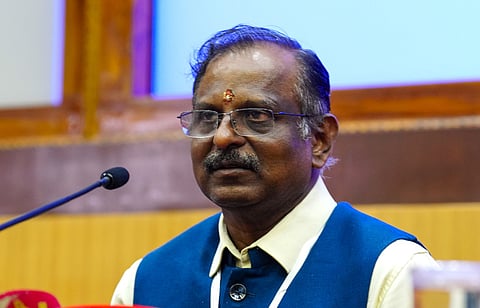
ISRO Chairman V Narayanan said this on Friday on the sidelines of a national workshop on “Hydrogen Fuel Technologies and Future Trends”, held at Alliance University, Bengaluru, in association with the Indian Institute of Science (IISc). In his address at the workshop, he said the world today faced twin challenges of growing demand for energy and the urgent need to reduce greenhouse gas emissions.
“In this context, hydrogen, one of the greenest and cleanest fuels available to us, is a beacon of hope. It remains key in many of our breakthroughs at ISRO,” he said, adding that in January this year, India launched the GSLV MkIII rocket – its 100th successful mission – and it was powered by a cryogenic stage using liquid hydrogen and liquid oxygen, “a technology once denied to India but now mastered by the country”.
Hydrogen highly combustible, needs cautious handling, says ISRO chief
Narayanan, however, cautioned that handling hydrogen fuel was extremely dangerous as it was highly combustible, and cited a tragic instance in which a hydrogen leak during one of the tests at a plant caused grievous burns to one of his colleagues.
“We must never ignore the safety risks: with vast hydrogen facilities, the scale of potential danger is real. This highlights the urgent need for better hydrogen sensors, moving from the current 3 to 4 second response times to millisecond-level detection,” he said, calling it a challenging task, and indicating that works were already being planned to develop such sensors so launches of larger missions in future – like India’s indigenous space station, Bhartiya Antriksh Station (by 2035) and the manned Moon mission – using hydrogen fuel as propellant could be safer.
He, however, also pointed out: “Beyond rockets, hydrogen has applications in aircraft, trains, automobiles and fuel cells. In 2010–11, ISRO and Tata Motors collaborated to build a hydrogen fuel cell-powered bus, which was safely tested despite concerns, proving our confidence in the technology. In June 2025, five hydrogen-powered buses began commercial operations. Companies like BHEL (Bharat Heavy Electricals Limited) and NTPC (National Thermal Power Corporation) are now working on hydrogen systems and gas turbine engines.”
Dr Vijay Kumar Saraswat, Chairman, Combustion Institute – Indian Section (CIIS), and Member, NITI Aayog, said safety and handling demanded advanced research, especially for internal combustion engines, fuel cells and rocket applications.
“As nations like China move ahead with hydrogen-methanol technologies, India must intensify indigenous R&D, build testing infrastructure such as 700-bar storage systems, and innovate in new storage materials. Hydrogen IC engines and carriers like methanol are particularly vital for heavy-duty transport and marine sectors, where batteries fall short. This is the time for India to go beyond imitation, invest in self-reliant hydrogen solutions, and position hydrogen as the bridge between fossil fuels and renewables in our energy transition.”
