
Voices of intolerance, verging on bigotry, came to the surface when the Karnataka government confirmed that International Booker Prize-winning author Banu Mushtaq would inaugurate Mysuru Dasara.
What many regard as a symbol of Karnataka’s collective culture was suddenly turned into a stage for outrage, where calls for exclusion grew louder. Yet, Mushtaq stood her ground.
“A message of peace and harmony” - that was the note she chose to strike after inaugurating the festival on Monday.
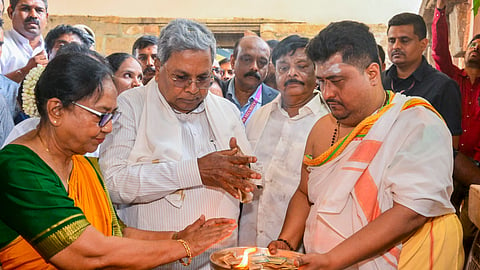
The famous 11-day Dasara celebrations began in the city of palaces with Mushtaq offering prayers at the Chamundeshwari temple, showering flowers on the idol of the goddess during the auspicious "Vrushchika Lagna", as priests chanted Vedic hymns. She was joined by Chief Minister Siddaramaiah, and together they performed the rituals that have marked the start of the festival for generations.
For Mushtaq, the moment was a bit more personal.
“I had already said during an interview that one of my writer friends in Mysuru had prayed for Goddess Chamundeshwari, when my name was nominated for the Booker Prize and took a vow of bringing me to the temple, due to some reason I couldn't visit earlier, but the Goddess Chamundi has called me through an invitation from the government," she said.
That call, however, came messily wrapped in controversy with a saffron bow.
Her selection drew sharp resistance from some leaders and groups, who questioned why a “non-Hindu” was chosen to inaugurate what they insisted was a “Hindu religious festival.”
Critics dug up an old video in which she had questioned the worship of the Kannada language as Goddess Bhuvaneshwari, calling it exclusionary for minorities like her. Soon, allegations of being “anti-Hindu” and “anti-Kannada” filled the air.
Union minister Shobha Karandlaje questioned, "Does she have faith in Goddess Chamundeshwari, when she has no faith in Goddess Bhuvaneshwari. The government says Dasara is a cultural festival and not a religious festival. I want to know since when Navratri ceased to be a religious event?"
Mysuru royal scion and MP Yaduveer Wadiyar too voiced opposition, saying, "I am not questioning her religious beliefs but want her to respect the religious beliefs and traditions of others. Let her clarify her stand on the Hindu religious beliefs."
Mushtaq’s response came not in sharp rebuttal but in her words from the podium.
“At a time when the world is moving on the path of war and humanity is immersed in hatred and bloodshed, let Mysuru Dasara send out a message of peace and harmony, as this is the garden of peace for all communities,” she said.
She spoke of culture as something that must unite, not divide.
“Our culture is our root, harmony is our strength, and economy is our wings. Let's build a new society that is filled with human values and love, along with our youth in India -- that is also strong educationally, economically, and industrially. Let everyone have an equal share and opportunity in that society.”
The goddess herself was at the centre of her address. Mushtaq called Chamundeshwari “a symbol of power in woman and her undefeatable will power.”
She added, “Womanhood stands not only for softness and motherly affection, but also for strength that fights injustice.”
To those who questioned her place at the temple, she recalled her many interactions with Hindu traditions.
"I have been to various events, have been invited to many, I have lit lamps and offered flowers a number of times and have accepted Mangalarati. This is not new to me. Mother Goddess Chamundeshwari has called me here and I have come before you from her presence (at the temple)."
Her words did not stop at religion, it went beyond it.
"Chamundeshwari is the symbol of strength, courage, motherly affection and protection. May she destroy hate and intolerance in us."
She urged people to defend democratic values and respect each other’s beliefs.
“Let this land become a symphony of harmony and unity. Democracy is not just a system but a value, and respecting it is the duty of everyone.”
Mushtaq also reflected on what culture had taught her: “Culture is something that bridges and unites hearts, spreading love is its aim, not hate. The culture of this land has taught me the lesson of respecting all.”
For her, true strength lay not in weapons but in letters, not in hatred but in love.
Addressing the gathering after the inauguration of Mysuru Dasara, Karnataka Chief Minister Siddaramaiah said, "If we accept humanity, we should accept people belonging to any caste, religion or class --participating in the celebration of Nada Habba. Majority of the people of this state have accepted Banu Mushtaq inaugurating Dasara."
"Banu Mushtaq inaugurating Dasara this year is a right decision and it is something that has brought respect for Karnataka. So I congratulate Mushtaq on behalf of the people and the government," he added.
Pointing out that the High Court and Supreme Court have taught proper lessons to those who approached them opposing the government's invitation to Mushtaq to inaugurate Dasara, the CM said courts have asked them to read the preamble of the Constitution.
"Everyone should understand that our Constitution is secular. We are a society where there is unity in diversity, irrespective of our religion and castes, we are all Indians. Those who are opposed to the Constitution try to distort it, such people are selfish," he said.
Appreciating Mushtaq's inaugural address, Siddaramaiah said even he cannot speak like her.
The legal challenges had already been settled by the time she took the stage. Just a week earlier, the Supreme Court had dismissed a plea against the Karnataka High Court’s decision to uphold the state government’s invitation to her. With that, the path was cleared for the festival to begin.
In the end, the uproar said more about the anxieties of our times than about the woman at the centre of it. Mysuru Dasara went on as it always has - priests chanting, flowers offered, rituals performed. The sky did not collapse, traditions did not crumble.
What lingered instead were Mushtaq’s words, reminding that culture at its best is not a weapon to divide, but a bridge to hold us together.
