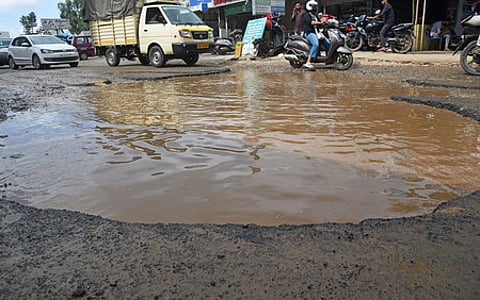

The state capital has 470 major roads, covering 1,344.7 km with nearly 50% having potholes, while the traffic department has identified 4,830 potholes on such roads. A logistics firm is considering the prospect of relocating from Bengaluru, citing traffic and long commute times. The city’s chronic road and traffic issues remain at the front and centre.
Residents wonder if roads will ever be pothole-free, traffic problems will ever be fixed, and regular flooding will ever end. Back-to-back incidents related to potholes in a week has highlighted the terrible road infrastructure in Mahadevpura, the IT belt.
Last week, a school van carrying 20 children hit a road-side ditch and tilted dangerously in Panathur. Even as the city administration rushed to fix the blot, a logistics firm announced that it is moving out of Bengaluru, which hit national headlines, giving a body blow to Bengaluru’s image as IT capital again.
Industry stalwarts like Kiran Mazumdar-Shaw and Mohandas Pai cautioned the government, asking it to fix the crumbling infrastructure. Shaw said the government should address the issue on an emergency basis, while the opposition BJP launched a scathing attack on the government over badly managed city infrastructure.
In ‘an attempt to fish in troubled waters’, Andhra Pradesh Minister Nara Lokesh invited the company to Vizag, putting the government and Greater Bengaluru Administration under a tight spot.
Over 1,500 parents from schools across Bellandur, Sarjapura, Whitefield, Panathur, Varthur, Thubarahalli, Balagere and surrounding areas petitioned the city traffic head about 25,000 schoolchildren getting stuck in traffic for two hours every day due to traffic and potholes, and sought his intervention to help them.
After an inspection, the Bengaluru Traffic Police recently wrote to the additional chief secretary, Urban Development Department, stating that the city’s arterial roads have 4,830 potholes, leading to traffic chaos.

Deputy Chief Minister DK Shivakumar, who is also Bengaluru Development Minister, announced Rs 1,100 crore for road works, asking city MLAs to focus on potholes and bad stretches in their assembly constituencies. He claimed that 7,000 potholes were fixed and another 5,000 are being filled on a war-footing. He set November as the deadline for contractors and engineers to fix all potholes.
Ashish Verma, a mobility expert from the Indian Institute of Science, said the pothole-filling constitutes a ‘circular economy’. Funds allocated will only benefit contractors and engineers. “There is an economic cost associated with bad roads. Pedestrians and two-wheeler riders get injured and lose their lives in some cases while trying to avoid potholes. Hospitalisation and insurance compensation is an economic burden on the public as well as the government,” he explained.
He said that apart from time lost during travel and loss of productivity, bad roads also worsen air pollution due to dust rising from potholes and vehicular pollution.
D Prasad, member, Indian Road Congress, said the corporation should use good quality bitumen while fixing potholes. “Before laying bitumen, base correction is a must. It means weak points have to be identified, which, if ignored, will end up in potholes. The corporation will have to use Polymer Modified Bitumen for durability of roads,” he says.
“The drainage system has to be fixed and water should flow from roads to drains. Work should be avoided during the rains. The Greater Bengaluru Authority should come out with a strict defective liability period clause against executive engineers working on the road project,” he adds.