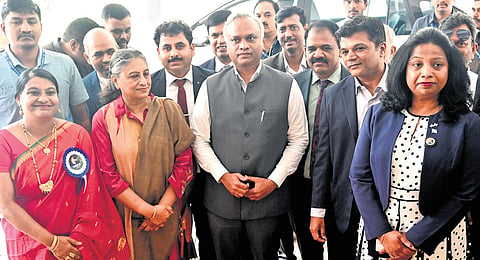

BENGALURU: “Artificial Intelligence (AI) must become a force multiplier in addressing some of the world’s most pressing challenges and accelerating progress towards Sustainable Development Goals (SDGs),” IT/BT and Home Minister Priyank Kharge said here on Wednesday.
Kharge was speaking at the inauguration of an international conference on ‘Leveraging Artificial Intelligence to Advance Sustainable Development Goals’ organised by the Wolverhampton–Bengaluru Centre for Research & Innovation (WBCR&I).
Referring to the United Nations’ SDGs, Kharge said significant inroads were yet to be made despite global efforts towards eliminating poverty, improving healthcare, ensuring quality education, reducing inequality and addressing climate change.
According to him, AI presents an unprecedented opportunity to bridge these gaps, provided it is deployed responsibly and with a clear focus on improving people’s lives. “It is not a saviour, and it has no conscience, no courage and no compassion.
But in the hands of people who possess conscience, courage and compassion, it becomes a force multiplier. The real question before us is not whether AI can solve our problems, but whether we will use it responsibly to solve the challenges that matter most,” he said.
According to Kharge, in the movement towards achieving the SDGs, it is imperative that technology remains human-centric. He saw AI’s end goal in empowering doctors to save lives, farmers to improve productivity, governments to serve citizens better, and young innovators to build solutions that create meaningful impact. He also added that the grant offered to selected startups from the state will be increased to Rs 1 crore from the next year.
The IT/BT Minister reiterated the state government’s intent and commitment towards fostering responsible AI innovation, citing its investment in building the country’s first dedicated university for training students to leverage AI.
AI’S ADVERSE ECOLOGICAL IMPACT UNDENIABLE, SAYS IISC PROFFESOR
BENGALURU: The current energy and resource demands of artificial intelligence and its large-scale operation are environmentally unsustainable, according to associate professor at the Centre for Nano Science and Engineering, Indian Institute of Science Prof. Sreetosh Goswami. He was delivering a talk on ‘Molecular Neuromorphic Building Blocks for Artificial Intelligence’ at the Bengaluru India Nano 2026 on Wednesday.
“If you want to change an AI model in its entirety, it will end up consuming around 7lakh litres of water. The amount of carbon footprint AI usage and training leave behind are equivalent to going to the Moon and back,” said Prof. Goswami, shedding light on the adverse ecological impact of AI use. Talking about the kind of hardware on which AI is currently platformed, Prof. Goswami cited memory as the key limitation, and not computing power.
“We are today not limited by computational power, but memory (on chips). Computing architectures need to be rethought with the present memory shortage in mind,” he said. Given the present context, including the ecological effects, he sees the future of AI not consolidated in data centres, but more individually localised, offering brain-inspired neuromorphic computing as an energy-efficient alternative.
