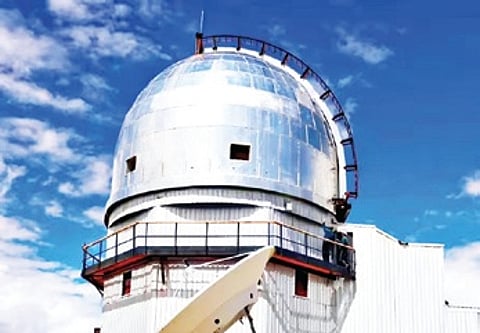

BENGALURU: In her 9th consecutive Budget presentation, Union Finance Minister Nirmala Sitharaman on Sunday announced funds for upgrading the Himalayan Chandra Telescope (HCT) at Hanle, Ladakh, besides establishing the National Large Solar Telescope (NLST), the National Large Optical Infrared Telescope (NLOIT) and the COSMOS2 Planetarium as part of boosting the country’s telescope infrastructure.
Experts in the Department of Science and Technology said the HCT celebrates its silver jubilee this year, and it was the main telescope so far, needing upgradation in secondary and control systems among others.
“We had sought robotic telescopes, larger range lenses and even addition of more telescopes. The NLOIT, the largest telescope of India with a range of 8–13 metres was proposed to be set up in Digpa Rasta Ri, now known as Mount Saraswati, in Ladakh. It was designed with remote operation capability and optical and infrared sensing.
This is the need of the hour for keeping India on the developmental track," an official said. The telescopes will be installed and developed by Bengaluru-based Indian Institute of Astrophysics. The aim of the government is to complete their installation and start operations in 5–10 years.
In November 2025, the IIA signed an MoU to set up COSMOS2 Planetarium in Amravati, Andhra Pradesh. The 2026–27 budget has allocated Rs 10,397 crore for the space technology sector and Rs 1,725 crore for the space applications. In the last fiscal, the allocations of Rs 10,230 crore and Rs 1,707crore, respectively, were revised to Rs 9,602 crore and Rs 1,596 crore.
However, although experts are delighted with the budget announcement, they lamented that nothing was announced for ISRO, particularly with the agency planning an ambitious space mission line-up ahead.
