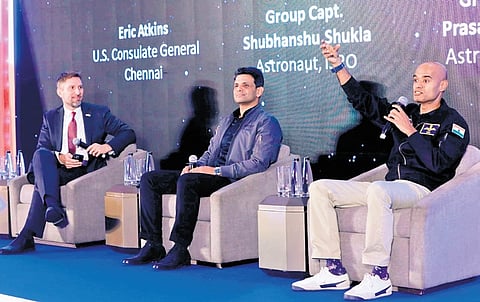

BENGALURU: Group Captain Shubhanshu Shukla of Indian Space Research Organisation (ISRO) on Wednesday said the extent to which the country’s foray into space research will yield applications in daily life can only be measured in hindsight, and although he is not sure of what the applications will be at present, he is certain of their potential existence.
He was speaking at a panel discussion on bilateral space policy on the final day of the US-India Space Business Forum.
A key focus area of the discussion was ISRO’s Gaganyaan programme, which is set to make India only the fourth nation in the world to conduct human spaceflight operations after Russia, United States of America and China. “The Gaganyaan mission is already under way; preparations for test flights are under way,” he said.
NASA and Space X’s Axiom Mission 4, whose pilot was Shukla, marked the first instance of an Indian astronaut being aboard the International Space Station (ISS). “The experience was very enriching. When I roamed around the training facilities, historical trivia was all around me. The pad from which we launched, for example, was the same one from which Apollo 11 took off. The environment was really friendly,” he said.
Shukla added that the fact that Earth’s borders cease to be visible when one is in space, was evidence that efforts towards space research would only be fruitful if they were collaborative in nature, not competitive.
Also part of the panel was Group Captain Prasanth Nair, an ISRO astronaut who was incidentally the pilot of the backup crew of Axiom Mission 4. Nair shed light on the emergence of space laws that he said would come up with humankind’s increasing presence in space.
“It is important to know the legality and diplomacy of space. When monarchs colonised lands, they wanted to colonise oceans as well; space is the new ocean. India has a very important role in this, as a trust-based society. Our presence in space is the presence of such a society; that trust factor will be integral,” he said.
