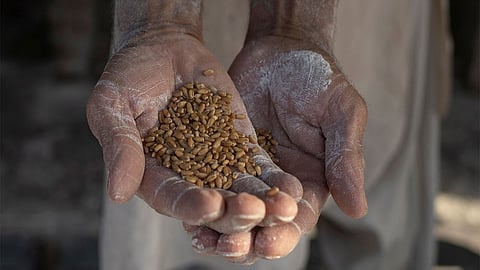

HUBBALLI: Chandrappa Hadimani, a farmer in Malali village, located 15km away from Hubballi district headquarters, has cultivated 42 varieties of wheat on his 30,000 sq feet agriculture plot to test which one will adapt to the local soil and climate. These include some rare varieties, including Paigambari, a crop cultivated in ancient Indus valley. Hadimani’s wheat crop will be ready for harvest in a few weeks.
Hadimani cultivated all varieties of wheat with the seeds he collected from Sahaja Samruddha, a farmers’ network.
“This is the second year he is cultivating so many varieties of wheat. Last year, too, there was a similar experiment, but the yield was unsatisfactory. This year, we hope that it will be a great success,” said G Krishna Prasad, the director of Sahaja Samrudda.
Hadimani said he cultivated these varieties as a rabi crop. “Wheat is a temperate crop cultivated post monsoon, and does not need much water. We have brought all these varieties from various parts of the country, including Karnataka, Odisha, Gujarat, Maharastra, Punjab and Assam,” he informed.
The plots were divided and numbered before cultivation. “We are studying the growth and yield and categorising them to find the best varieties for local cultivation. Some are very unique in nature.
The black wheat Hadimani cultivated is said to have anti-cancer properties.
Kumar Lamani, a senior agro scientist who visited the plot, appreciated Hadimani’s efforts. He said, “Scientists have developed a crop which requires irrigation, but such crops are not good for cattle feed. Only the dryland varieties are the best for human consumption and cattle fodder,” he said.
Some varieties have a unique history, too. For instance, the Amrut wheat cultivated in and around Annigeri is linked to lord Amruteshwara, the temple deity at Annogere. Bijiga, another variety, is popular among the farmers of Savadatti. Some varieties have come from places like Gujarat.
The Paigamabari is a round grain variety that was widely cultivated when the Indus Valley Civilisation was at its peak. “It was found by a Gujarat-based agriculture expert Padam Jain. He shared the variety with us. It is suitable for cultivation in Indi taluk of Vijayapura district because of the climate there. Paigambari cultivation was mostly concentrated in north-west India – Sindh, Punjab and Saurashtra. It is available in both black and red grains,” said Prasad.
Some of the other wheat varieties found on the farm are Sarbathi, Munda Pisa, Godavari, Dabbli, Red Amrut, Barnalla, Garur, Jave, Swarna and Kudrat.
