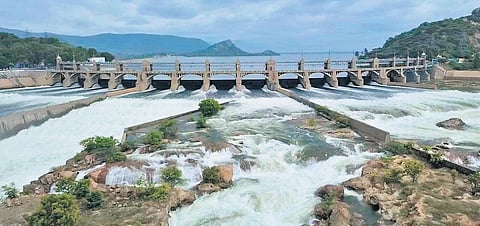

BENGALURU: Karnataka received good rainfall last year raising hopes of trouble-free months ahead, but the reality is different: Ten of the state’s 13 major dams now have lower storage than the previous year. That is because of evaporation of water from dams because of rising temperatures, while severe overexploitation has affected groundwater quality.
Experts warn that drinking water could be a concern in some parts of the state this summer.
As per data from the Karnataka State Natural Disaster Monitoring Centre (KSNDMC), water storage at all 13 dams was 535 thousand million cubic Feet (tmcft) in 2025, but now, it is 493 tmcft, a difference of 42 tmcft. While the Tungabhadra dam had close to 40 tmcft of water last year, it has reduced to 24 tmcft now. Similarly, the Linganmakki dam has 87 tmcft now, as against 78 tmcft last year.
The water level at the Supa dam has come down from 82 tmcft to 77 tmcft. There has been a slight increase in Krishnaraja Reservoir. While it was 37.88 tmcft last year, it is 38.64 tmcft now.
As against the total capacity of 895.07 tmcft in all the 13 dams, the storage is 493.91 tmcft, which is 45% of the capacity.
Broken crest gates at Tungabhadra dam last year restricted water storage
Former KSNDMC director Srinivas Reddy said water could not be stored at the Tungabhadra dam as the crest gates were broken and water was lost last year. Though the catchment areas received a good rainfall, the reservoir could only store 70% of it, he explained. That leaves farmers in dire straits with no water being supplied to farms as drinking water needs are the priority.
Explaining the loss of water, Reddy said rising temperatures are causing water to evaporate. “Also, there has been water loss from plants due to transpiration. Water released from plants also means that more water is needed for farming as plants demands more water,” he said.
Sources from the Disaster Management Cell told TNSE that because of severe exploitation of groundwater, 43 taluks are already facing a water crisis. Also, certain pockets in Bengaluru that are depending on borewells will also face a crisis.
Officials said that over 500 villages across the state may also have issues with the quality of water because of severe exploitation of groundwater. Experts have appealed to the people to use less water and not to waste the precious commodity. As drinking water is the priority, water should not be used for other purposes, they advised.
