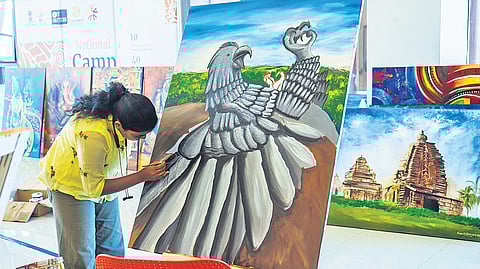

BENGALURU: Old and familiar Panchatantra stories are finding new visual expression at the national art camp, where young artists are reimagining the ancient fables through diverse traditional Indian art forms while learning directly from hereditary practitioners.
Organised by Bengaluru-based Yuvaka Sangha under its Art Matters forum in collaboration with the Indian Knowledge Systems division of the Ministry of Education, the camp brought together 400 fine arts students from 17 states. Selected from more than 1,000 applicants, participants are interpreting 84 Panchatantra stories across ten classical styles, including Mysore painting, Kalamkari, Kerala mural, Thanjavur mural, Chitrakathi, Pattachitra, Gond art, Mata ni Pachedi and Madhubani.
Organisers say the Panchatantra was chosen for its enduring relevance and its ability to convey values such as intelligence, friendship, courage and ethical decision-making through animal fables. Rendering the same stories across multiple regional styles allows students to see how visual language changes with geography while the narrative core remains intact. The initiative also aims to address the limited availability of authentic Indian visual references for students and schools.
Students are assigned a single art form and mentored by senior traditional artists, many of whom have inherited these practices across generations. The process begins with story narration and sketching sessions before final works are executed on canvas. Organisers estimate that about 840 artworks will be completed, with emphasis on regional aesthetics and iconographic accuracy.
Shivaprasad, mentor and in-charge, Art Matters, said the effort is intended to make traditional visual forms more accessible to young learners. “When children look for images, they often find material from outside India. Through this project, we are creating a repository rooted in our own stories and artistic traditions,” he said.
For participants, the camp has become a space for both technical learning and artistic exchange. Bhupendra Singh Chauhan, a first-year Master’s student in painting at Rahini College of Art and Design, Indore, said the residency helped clarify distinctions within traditional practices and deepen his understanding of regional techniques.
He added that demonstrations by mentors, even within a limited timeframe, provided insight into processes that usually take 15 to 20 days for a single work. “Working with artists from across India, sharing techniques and learning about their methods has been very helpful. Camps like this help us grow and connect as artists,” he said.
The camp is being hosted at Chanakya University from February 13 to 27. Once digitised, the artworks will be reproduced for display in Jawahar Navodaya Vidyalayas nationwide.