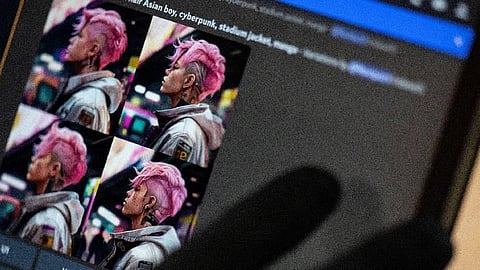

Given how omnipresent AI is in how we access and derive from the internet, I have forced myself to think about if we need it at all. And no matter how open minded I try to be, what refuses to change is just how much I loathe AI in art.
I loathe the glitchy videos it produces. I loathe the perfect but soulless photo captions and the Ghibli-fying of photos (going against everything Studio Ghibli’s co-founder Hayao Miyazaki wished for his exemplary art). I loathe AI trying to summarise the PDF of a book I’m reading because it is a long document.
I am not anti-technology, let this too be clear. The internet is a marvellous thing if you choose to spend your time on it wisely. And AI is making immense progress in science, medicine and such other necessary life things. We are all likely benefitting from its use in more ways than we realise.
But I also wonder how we got to a stage where AI turning against its creators in a Frankensteinian/Black Mirror horror show is a fear so real that OpenAI recently announced a vacancy for a ‘head of preparedness,’ a human person responsible for anticipating and defending against what AI might do to put humanity at risk.
In the marvellous film Dead Poets’ Society, Robin Williams’ character notes that engineering and law and business and such like are noble pursuits and essential, but, he continues, “But poetry, beauty, romance, love, these are what we stay alive for.”
‘To think of AI and its effect on us is to really think of what it is to be human’
When we turn to a song, a book, a funny clip, or turn our face up to the night sky and look for a star, or catch a slight breeze in the peak of summer afternoons, or smile at a pup, or see a leaf move and hear the music of birdsong, or chance upon an old memory, these and thousands of little intermissions like these to our days are when we are within reach of something greater and wider than the scope of our ordinary lives. We are human because we make mistakes. Indigenous beaders intentionally add a wrong-coloured spirit-bead in their creation to acknowledge that no creation should be or is meant to be perfect. It is also meant to remind themselves of humility, a quality without which any art making is but an insult to the form.
To think of AI and its effect on us is to really think of what it is to be human. It is to remember why we make anything at all, why there is extraordinarily good art and mediocre art and bad, bad art in the world and why all these are equally important.
AI will likely tell you that Werner Herzog’s Cave of Forgotten Dreams (2010) is a documentary on some of the earliest cave paintings found in the world, in France, at least 20,000 years old. But it will not tell you that Herzog stands there mesmerised, in awe of being given access to it and we, as viewers feel the same sense of overwhelm that meets him meeting art made for no discernible purpose.
AI will tell you that A R Rahman rose to fame scoring Mani Ratnam’s Roja (1992). But it won’t remind you that there is a second in the song Pudhu Vellai Mazhai/Yeh Haseen Vadiyan when the music soars and a beat drops and it sounds like a thousand crystals shattering across a marble floor. Something breaks in the listener, and it is as if a world has shifted. As the music landscape in India indeed did because of ARR.
How can art be art if it does not carry the weight of the artist’s experiences? Some feral trigger is pressed, like a thumb on a fresh wound, when I am told AI-generated art is good art.
Art is that which must be made from life, from grief and joy, from the drudgery of everyday experiences, from the mundane. What can a machine know about heartbreak that can make you feel like every cell is shattering across the floor, or of pleasure that makes you feel like you are being reborn? Can a machine feel? Can it ever be sentient?
For long, we have thought of the purpose of art. Herzog questions this too in his documentary. For why would early humans, trying to survive in the harshest possible terrains, bother to paint on hardly accessible walls? We don’t know. We will probably never know. Does art need a utility value at all is another line of thought. Art is never not political.
I think of Govind Nihalani’s Party (1984), based on Mahesh Elkunchwar’s play. The whole film is a party where a group of liberal elites discuss art and politics over whisky and cigarettes and dinner. The closing opinions, on whether the art and the artist can and should be separated, whether aesthetics are more important, or social responsibility, are essential study even today for those of us in fields of cultural influence.
The most powerful thought, for me, is where a character expresses the possibility of two moral commitments at the same time, where a person might take a stand against something as a human being, but not necessarily as an artist in her art making. To me, such complex questions, and the rationality required to hold two opposing arguments, political or otherwise (not the narrow scope of electoral politics, mind you) at the same time in debate is the space where the potential of art is ideally created.
I have yet to see a machine learning model being able to intentionally put in spirit-beads or juggle complex thought processes. Nor have I seen any that can refer to seemingly random music or films books, without prompts, to make long-winded, open-ended arguments. Naivety? Perhaps. But humanity has survived bigger wars than these capitalism-driven assaults on our common sense and good taste. We should be fine. Eventually. Or so one hopes in what I am told will be the great year of analogue, 2026.
