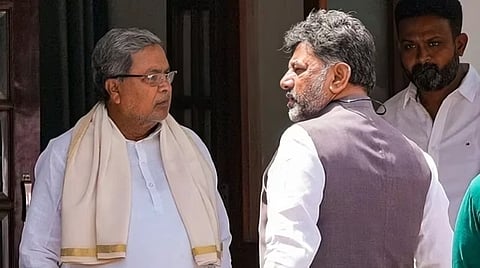

The new year started with a positive note for the embattled Chief Minister Siddaramaiah, who is all set to surpass veteran Congress leader Devaraj Urs’s record of being the longest-serving CM of the state for 7.6 years (2,792 days). Breaking the record on January 7 assumes special significance for the Congress leader and state politics, as it comes amid speculation over the leadership change. He now sets his eye on further strengthening his own record by presenting the 17th state budget.
As we bid adieu to 2025, marked by political uncertainties, we step into the new year, which promises to be politically action-packed, with many significant developments that would have long-term implications, deciding the course of state politics in the future.
The leadership issue would be settled one way or the other. No decision will also mean a decision. The status quo on the leadership issue would be a clear signal for Deputy Chief Minister DK Shivakumar to wait a little longer. The DyCM’s followers are hopeful that the change is imminent.
The CM and the DyCM are likely to meet the Congress central leaders including Rahul Gandhi in New Delhi on January 11. Those privy to the developments maintain that the agenda of the meeting is not clear, but the leadership change is not off the table.
The uncertainty will linger on until the Congress high command announces its decision unambiguously and follows through. That would continue to be one of the core issues for the opposition BJP-JDS combine to target the Congress government and set a narrative against it.
With assembly elections in neighbouring Kerala, Tamil Nadu, and Puducherry likely to be held in the coming months, the Congress will be extremely cautious about its political moves in Karnataka.
As electioneering in Kerala gains steam, its heat is felt in Karnataka. The manner in which the state administration announced its decision to provide houses to those evicted from the government lands in Bengaluru, after it became an issue in Kerala, showed how touchy Congress is about developments in Karnataka impacting its prospects in elections in neighbouring states.
While giving houses to the homeless is an administrative obligation, the manner and the speed at which the decision was announced raised several questions: Will the government take a similar stand in future when encroachments are cleared? Why is it not showing the same alacrity and humanitarian approach to provide houses to all homeless people in the state?
While trying to deny a political issue to its I.N.D.I.A bloc partner Left Democratic Front (LDF), which is the main political adversary of the Congress-led United Democratic Front (UDF) in Kerala elections, the Siddaramaiah’s government seems to have entered into a fresh controversy.
After facing flak, the government is now scrutinising applications from those evicted from the government land. The government needs to handle the issue deftly.
The other major issue that is likely to rock the state politics in the coming months would be the Socio-Economic and Education survey, or the caste census report. It is expected to be submitted soon by the Karnataka State Commission for Backward Classes. Given the manner in which dominant communities had reacted to the leaked contents of the 2015 survey report that was eventually binned, the new survey, too, is likely to create a political storm. Vokkaligas and Lingayat communities, which are numerically dominant in South and North Karnataka regions, respectively, had expressed concerns over the undercounting of their population and improper sub-classification of castes.
The timing of the new report will be crucial. Many in the political circles feel that if the report comes before the leadership issue is settled, it could help strengthen Siddaramaiah’s position, as his supporters project him as the champion of minorities, backward classes, and Dalits.
Apart from the Congress’s internal developments, the survey report would have far-reaching implications on the state’s politics and governance. It would be prudent for the commission to do due diligence on the processes adopted and be fully transparent, so that it inspires trust and minimises the scope for doubts and skepticism.
While the caste survey report is bound to stir a political debate, another report that is being eagerly awaited by people of the North Karnataka region is that on addressing the regional imbalance. The committee, headed by economist M Govind Rao, is expected to submit its report in the next few weeks. The implementation of its recommendations could be part of the state budget announcements. This will be the most significant report after Prof DM Nanjundappa’s committee report submitted to the state government in 2002. It had identified 117 taluks as backward, and the implementation of the report had started in 2007-08. However, after nearly two decades of implementation, the regional imbalance still continues. The Govind Rao committee is expected to look at the reasons and suggest measures to address them.
On the political front, the local body elections, including polls to the five corporations in the newly formed Greater Bengaluru Authority (GBA) and Zilla Panchayats and Taluk Panchayats, are likely to generate a lot of action. Keen to have full control over the five corporations in the state capital, the ruling Congress has already begun its work, and the BJP and JDS have also set the ball rolling.
Elections aside, a large number of people from economically weaker sections in rural areas could find themselves in crosshairs of Centre-State politics. Siddaramaiah government has slammed Centre’s move to replace MGNREGA with the Viksit Bharat-Guarantee for Rozgar and Ajeevika Mission (Gramin) (VB-G RAM G) Act, 2025. A lot depends on its stand on implementing the new Act.
