
2025 in the history of the Republic of India would be prominently remembered as the year it fought its first high-technological precision-strike battle of the escalatory kind, Operation Sindoor, against the global terror hub of Pakistan.
ISRO, in a departure from its earlier reticent posture, announced the pinpointed strikes at terrorist-cum-military installations deep inside the enemy territory that were, to a great degree, made possible by the country’s space capabilities. The acknowledgement, little noticed, made it amply clear that India is now operating a civil-military fusion space programme.
2026 will be a revelatory year for the Indian space programme, as it will adapt to the fast- shifting global paradigm. The world is confronting four significant challenges analogous to those experienced in the 1930s -- a period of protracted conflict, demographic upheaval, decelerating growth in Western economies and the rapid obsolescence of the institutions that have supported the world order established in the 20th century.
These challenges are fomenting protectionism and autarky; a notable illustration is the transformation of the US Department of Defence into the Department of War, which signals the United States’ readiness for deglobalisation and geoeconomic multipolarity. Europe too is transcending towards a war economy. Consequently, these challenges are expected to impact the globalised space economy adversely in 2026.
India’s emerging commercial space sector has experienced rapid developments with aspirations over the past five years to establish enduring international business connections within the Western space market. The responses elicited from governments for India’s Op Sindoor have offered a reality check to the Indian commercial space sector. The commercial space sector and the Department of Space will reevaluate their international cooperation strategies and pursue space partnerships with nations that have genuine interests in India’s progress, given that India is the fastest-growing large economy globally.
India also is a crucial pole of the multipolar global order. In 2026, India will be required to assess aspects concerning its sovereignty and self-reliance in space technology, telecommunications and the space supply chain. The Indian commercial space sector must prepare to meet the needs of the armed forces and intelligence agencies in maintaining stability within India’s sphere of influence, which now includes outer space.
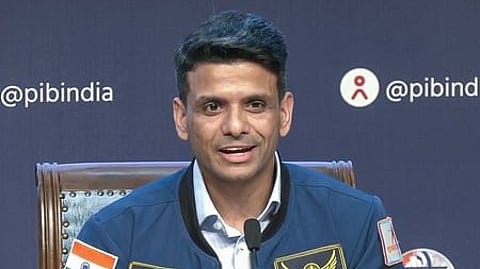
In 2026, India will embark on the Gaganyaan missions for its ambitious human-rated spaceflight initiative, which includes raising the Bhartiya Antriksh Station. The safety of Indian ‘vyomanauts’, especially those operating in low-Earth orbit, would prompt India to reflect deeply on the rampant occupation of low-Earth orbit, a finite space, by inconsiderately deployed satellite constellations.
The Chinese space station and the International Space Station are already facing significant issues related to densely packed satellites in the same orbits and the fragments they produce. However, since both space stations are built by conflicting factions, and the biggest constellations come from the same two countries, neither is ready to tone down the orbital squatter in the interest of the global commons in space. India will have to step up Gaganyaan; more than being an inspirational project, it will have to fulfil its duty to ensure secure and sustainable access for itself and for all nations in outer space.
2026 will also be an important year from the purview of new space launch competencies. The first commercial launch of the Small Satellite Launch Vehicle, ISRO’s newly developed launcher commercially built by Hindustan Aeronautics Limited, will happen this year. Also, the first-ever orbital launch of Skyroot Aerospace’s Vikram-1 would happen in 2026, giving the Indian space programme two small-satellite launchers that could meet on-demand launch needs. Not to forget, the solid-fuelled small satellite launcher that the defence forces are building for their quick-reaction applications, but are tight-lipped about, popularly known as VEDA, would also see progress in 2026.
In 2026, ISRO will showcase various innovative indigenous space technologies, including the travelling-wave tube amplifier for advanced space communications, quantum key distribution for secure encrypted communications, and high-thrust electric propulsion systems designed for agile, manoeuvrable satellites and spacecraft for interplanetary and cislunar missions. Many of these advancements are expected to become standard features in Indian satellites and spacecraft in the future.
The trivial silos of civilian, commercial, and military space ambitions established in the past are fast disintegrating. A civil-military-fused space programme dedicated to India’s strategic and security interests will emerge clearly in 2026.
