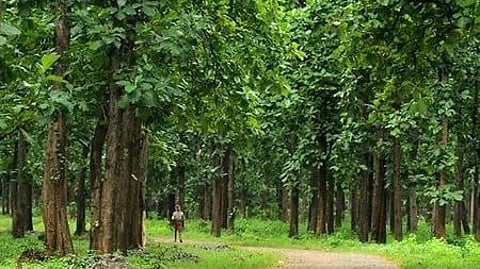

BENGALURU: At a time when many parts of Indian history are being altered, experts and retired forest officials have sought a change pertaining to teak plantation, saying it was not the British, but legendary Maratha leader Shivaji’s admiral who first started a teak plantation in India.
Teak is one of the primary trees found in many Indian forests, including Karnataka’s tiger reserves. It is considered an essential species for commercial forestry due to high demand because of its durability.
In textbooks for forest, agriculture and horticulture students, it is mentioned that the British introduced teak in India and the first treated teak tree was sown in May-July 1844 in a plot in Nilambur, Kerala by Henry Valentine Conolly, the then Malabar district collector.
“But ecologist Madhav Gadgil in the report -- Towards an ecological history of India -- noted that that Shivaji’s (founder of Maratha Kingdom of Bhonsle dynasty) admiral Kanhoji Angre started special teak plantations to build ships in the coastal district of Ratnagiri. Angre had planted them in 1680, nearly 164 years earlier to Conolly’s plot,” retired Head of Forest Force Brijesh Kumar Dikshit told TNIE.
But British foresters ignored this record -- which was described in the Campbell’s Gazetteer of Ratnagiri District, also called the Gazetteer of Bombay Presidency in Volume-X, Ratnagiri and Sawantwadi.
‘Menon should get credit for teak plantation’
The Madhav Gadgil report notes that Kanhoji’s plantations were raised around 1680 and were of seed origin. “The book - This Fissured land -- an ecological history of India -- written by historian Ramachandra Guha and ecologist Gadgil, states that the British saw destruction of forests as a symbol of political victory. In the early 19th century, after defeating the Marathas, the East India Company razed Kanhoji’s teak plantations in Ratnagiri. That is why now it’s not possible to find teak plot,” Dikshit said.
The book- ‘Forest Ecology in India Colonial Maharashtra 1850-1950’, that cited the minutes of Colonel Jervis, Chief Engineer of Bombay in 1843, stated that the Angria family planted and conserved teak southward from Kolwan beyond Aptie. This extended up to the Poona Market. There is also a description of extensive plantations further southwards of the Bombay.
Dikshit pointed out that credit should also be given to sub-conservator Chatu Menon, instead of Conolly, for the teak plantation. Documents show that Conolly was finding it tough to germinate teak seeds. Multiple methods were tried, like burying the seed in hay and burning it to break the outer tough coating. But all failed. They then boiled the seeds and planted them at big distances.
This was successful and it was adopted as the standard nursery plantation practice till the 12th century. They then realised that seeds that germinated in forests after forest fires should be used and planted close. Menon used this method to raise teak plantations in Nilambur and Malabar. He also trained others who raised teak plantations in Nuggur, he said.
